Highland Wildlife and Birdwatch Safaris, Guided wildlife excursions, Aviemore, Scotland
Highland Wildlife and Birdwatch Safaris, Guided wildlife excursions, Aviemore, Scotland Highland Wildlife and Birdwatch Safaris, Guided wildlife excursions, Aviemore, Scotland

Thursday, December 01, 2011


November 2011 was mainly unusually mild & pleasantly autumnal, but turned more wintry as the month went on, with high winds, heavy rain & floods, and then snow on the hills at the end - but still very acceptable , in comparison with the last two winters.........though the days are very short now, with less hours of daylight then there is darkness.
Incoming winter visiting birds kept our day-lists up into the 40's , whilst mammal day-list varied between 4-8 species.

Wildlife highlights included:

The Red Deer 'rut' continued well into November this year, probably due to the mild weather, though it was pretty much over by mid-month,with territories & mating rights established, and the hillsides are now a much quieter, safer, place!

The numbers of (distracted?) Red Deer on the hillsides proved irresistible to one particular Golden Eagle - which I managed to film actually attacking a good sized hind, chasing it at speed down a steep slope, presumably in an attempt to harry it into falling to it's death or serious injury - amazing stuff!

In fact, raptors in general are much easier to see in winter, with the days growing shorter, they have very limited hunting time, so a visit to suitable habitats usually brings results with a bit of patience...with Buzzards, Kestrels, Sparrowhawks & Peregrine Falcons all seen regularly.....even White-Tailed Sea Eagles were seen in one beautiful upland glen, well away from their more usual coastal haunts...

Spawning Salmon - as seen on the BBC's Autumnwatch programme, were very evident in the shallow, wild upper reaches of our local rivers - with much leaping, splashing and fighting for position viewed from incredibly close range - a super wildlife spectacle!

Our local Otters were not going to pass up the food bonanza provided by the (distracted!) spawning Salmon, and on two occasions at dawn, we were able to witness
Otters successfully taking pretty large Salmon from the spawning grounds - a great start to a safari!

Pine Marten were regular visitors to my baited site after dark - allowing me to show a number of very happy customers this very rare & elusive species for the first time - often at very close range - with their visiting times getting progressively earlier as the days grow shorter.

Geese were a big attraction this month, with us seeing some of the rarer species for this area, such as Bean & White-Fronted, alongside the more regularly seen Barnacle & Greylag.

Large flocks of Redwings & Fieldfares were seen , particularly after Northerly winds, so these were presumably visitors from colder climes....

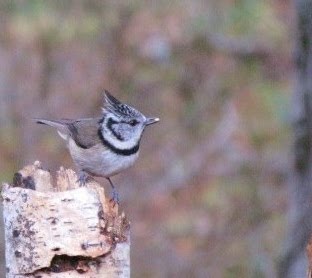
Crested Tits were seen regularly at forest feeding stations, giving good close range photo opportunities (see pic), along with dozens of Coal Tits, that are now so used to me, I can hand feed them with up to 3 on each hand at a time - a lovely interaction with nature!

Dippers continued to sing & perform well at dawn - some of my safari customers had seen Dippers before , & heard their distinctive 'zit' 'zit' calls, but none had ever heard their quite attractive, squeaky, scratchy song - often accompanied by a magnificent orange-pink sun rising over the River Spey - nice!

Mountainside species such as Ptarmigan & Mountain Hare were seen more frequently at lower levels as the tops became more snowy, and both were noted to be rapidly gaining their thicker, white winter coats.

Black Grouse numbers were seen to be increasing at or near traditional 'lek' sites, with up to 6 males being noted on some colder mornings.

The cock Red Grouse were also getting notably more showy & aggressive on the moors, as they start to try & establish territories ready for the breeding season.

The mixed Finch & Bunting flocks were seen to grow even larger on local farmland, with Bramblings now included in their ranks

Waxwings were also reported to be trickling into our area from the North & East, though not in the huge numbers of last year.

Monday, October 31, 2011


October 2011 was a kind of 'back to front' month weather-wise - it started cold with snow on the higher tops, was windy throughout, but ended surprisingly mildly with temperatures into double-figures - very unseasonal! The days are shortening noticeably now though, with almost as much darkness as daylight. Inward bird migration continued apace, with many winter Thrushes joining the early Geese & Wildfowl. Bird day-lists increased slightly into the 40's, whilst mammal day-list remained steady at 6-9 depending on our luck.

Wildlife highlights included:

The Red Deer 'rut' is always one of the highlights of any Autumn, and it is surely one of British nature's 'must-see' spectacles, with the magnificent fully antlered stags (see pic) corralling their 'harems' of hinds, defending them from other 'challengers' with much roaring, posturing & even actually fighting, & repeatedly mating with as many of their 'ladies' as possible - it's wonderfully entertaining , if a little brutal at times, and looks exhausting!.

The winter Thrushes poured in from the North, first the Redwings - usually heard before being seen - their thin 'seep seep' calls alerting us to the presence of the flocks flying overhead, followed a few days later by the Fieldfares. I think the berries on our trees & bushes may disappear very soon.....

Whooper Swans appeared on one of our large local lochs on the 5th, their dawn arrival preceded by their amazing 'trumpeting' calls while the flock of around 20 circled - I think I was the first 'local' to see them this winter, as I happened to be quietly fishing... a magic moment.

A trip into the Caledonian Pine forests at the foot of the Cairngorms gave us an amazing close-up view of 2 young Capercaillie - one male , one female - both just gaining their adult plumage - a rare treat to get a good sighting of arguably Britain's most endangered bird species...

A short afternoon visit to Insh Marshes RSPB reserve provided splendid views of a ring-tail (female)Hen Harrier hunting low over the marshland, and actually having a grab for a Mallard from one of the many shallow pools.

Mid-month, I witnessed some Dipper behaviour that I had never seen before - although I was aware that they start to compete for territory in Autumn - I actually saw 2 Dippers, fighting very aggressively - seemingly trying to drown each other!, on the surface in the middle of a good-sized loch - amazing stuff!

The Pine Marten - one of Britain's rarest & hardest to see mammals - was again a regular after-dark visitor to my baited site, putting smiles on many faces, with his arrival time getting progressively earlier as the days grew shorter.

Black Grouse numbers continued to grow at traditional 'lek' sites , as the Cock birds began their long build-up to the 'lekking' season with a little gentle posturing at dawn, especially on the colder mornings.

The mixed Finch & Bunting flocks on local farmland grew noticeably larger, with some now containing over a hundred birds of at least 6 different species.

Saturday, October 01, 2011


September 2011 started with cool, changeable weather, but, rather surprisingly, ended with a very mild & sunny spell, instead of the expected early autumnal frosts, and the days are growing noticeably shorter now.
With the last of the summer visitor bird species departing the area during the month, and just a few of the winter visitors arriving, bird day-list struggled to top 35 - 40 species, while mammal species remained steady at 6-10 depending on our luck.
As mid-late September is one of the 'quieter' times of the year for my safaris, I took some time off to visit relatives & friends down in the south of England, so this report may be a little shorter than normal.

Wildlife highlights included:

Last sightings for this year of summer visitors such as Osprey, Swallow, Wheatear etc - I found myself wishing them good luck on their migration to warmer climes, many as far south as Africa.

Winter visiting bird species began to increase, with good numbers of Greylag Geese & Mistle Thrushes being seen, and the first few Whooper Swans being reported at the end of the month.

Local speciality species still showing well included Dipper, Goldeneye, Goosander, Red Grouse, Black Grouse, Crested Tit & Crossbill, with occasional sightings of Capercaillie & Golden Eagle.

The Red Deer stags became noticeably more aggressive late in the month, with the first 'roaring' being heard, and the dominant males seemed to be assembling their 'harems' of females ready for the forthcoming 'rut'.

Crested Tits were noted to be coming to woodland feeding stations more frequently, especially on cooler mornings.

The mixed woodland flocks continued to grow in size, with some consisting of 100+ birds of 6-8 different species - but can you pick out the Cresties?....it's harder than you might think, and knowing their chuckling trill is a must!

Pine Marten was seen several times after dusk at a baited site, and we are now entering the best time of year in which to see them regularly as the number of dark hours increases.

Rowan trees are at their colourful, vivid red berry-laden best now, and the Thrush species are not slow to exploit this bumper autumn harvest.

A short trip West across to Mull produced great close-up views of 3 different Otters(see pic) and a super sighting of a soaring Golden Eagle along with all the expected seabirds such as Gannet, Guillemot & Black Guillemot etc - great stuff!

My trip south gave me the chance to see many species not seen this far north, and also gave me a 'life-tick' in the form of a very rare (& very pretty) Sabine's Gull- nice!

Saturday, September 03, 2011


August 2011 was yet another changeable month weather-wise, with some reasonably warm days earlier in the month, but a distinctly autumnal feel towards the end, with night-time temperatures dropping down into single figure. With migration of our summer visitors out of the area well underway, bird day-lists dropped a little down into the 40's, but mammal day-list figures remained steady at 6-10. Most of our family members & friends choose August to visit us up here, so my wildlife-watching opportunities were a little more limited than I would like,& consequently, this update may be a little shorter than usual.

Wildlife highlights included:

Seeing our local Osprey youngsters learning to fend for themselves. It often surprises my safari guests when I tell them that their Mother & then their Father desert them in August, leaving them to feed themselves, before they too embark on an unaccompanied journey to Africa at the age of just 3 months! amazing stuff!

Family trips to the Moray coast are actually a pretty decent wildlife-watching opportunity, with sightings including Ospreys fishing, Common & Arctic Terns, large flocks of Mergansers & Goosanders, many seaduck & wader species & good views of Yellowhammer (see pic)

Though several of our sought-after summer bird species such as The Divers & Slavonian Grebe, have now left the area, many of our 'local speciality' bird species such as Dipper, Goldeneye, Red Grouse, Crested Tit, Crossbill etc can all still be seen regularly, with occasional sightings of Golden Eagle, Capercaillie & Black Grouse...

Our local mammals continue to put a smile on my safari clients faces, with Red Squirrel, Roe Deer, Red Deer, Reindeer, Brown Hare, Rabbit, Mountain Hare, Mountain Goat, Bank Vole, Stoat, all being seen.

With the nights drawing in now, Pine Marten is back on the agenda, with us having several good after-dark sightings at our baited local site.

Sunday, July 31, 2011


July 2011 was, in keeping with the last two months, again, very changeable weather-wise, though we did manage to complete the month without a frost, with temperatures generally cooler than average. Despite the days shortening slightly, there were still 19-20 hours of daylight available for wildlife watching and still plenty to see.
Despite many of our wader species noticeably departing the area for coastal regions, we still saw bird day-list into the 50's, though we have now had our highest lists of the year. Mammal day-list remained steady at 6-10 depending on our luck.

Wildlife highlights included:

Osprey action! our local birds continued to put smiles on our faces with us enjoying seeing the birds plunge-diving to catch fish, delivering fish to the nests, eating the fish, and watching the youngsters learning to fly & fish for the first time - great stuff!

Close-up views of up to 7 Red Squirrels together at once at favoured feeding sites - a real treat for my safari clients from outside this area, many of whom had never seen our charming native species before.

Mammals! our early starts gave us many close-up sightings of (usually) very shy species such as Fox, Roe Deer & Brown Hare along with other species such asRed Deer, Reindeer, Red Squirrel, Mountain Goat, Mountain Hare, Stoat and Bank Vole, though the local Otters proved elusive.

Sought after local speciality bird species that continued to show well included Crested Tit, Dipper, Osprey, Crossbill, Red Grouse, Ring Ouzel, Slavonian Grebe, Red-throated Diver and Black-Throated Diver, many with youngsters, though Black Grouse became noticeably more difficult as the month progressed.

Though they were generally quite difficult to find, we did manage one super sighting of not one , but two Golden Eagles in the air together, gliding majestically along a high ridge in a beautiful upland glen - magic!

Amazingly, within a few minutes of the above Eagles sighting, we were then treated to the amazing spectacle of a pair of Peregrine Falcons teaching their youngsters to hunt, at a sheer cliff face, accompanied by lots of enthusiastic calling - a marvellous wildlife experience!

Butterflies! July & August are our best months for them this far north with most of the common species being seen along with several sighting of our local speciality - the pretty brown & orange Mountain Argus.

Towards the end of the month I spent a very enjoyable day on the North-West coast at the Scottish Wildlife Trust's beautiful Handa Island reserve. As if the fantastic scenery, azure blue seas and unspoilt golden beaches were not enough - the close-up views (and photo opportunities) of Great & Arctic Skuas, Seals, Red-Throated & Black-Throated Divers (see pic), Gannets, and nesting colonies of Arctic Terns, Razorbills, Guillemots, and , everybody's favourites, Puffins make for a memorable and highly recommended day!


The end of July, is for me, always tinged with a little bit of sadness, as I know that the next month will see many of our summer visitors start to depart this area for warmer climes, not to return until next spring......but at least I can say I that my job gave me many opportunities to see & enjoy them while they were here - I love my job!

Friday, July 01, 2011


June 2011 was, again, a very changeable month weather-wise, with some cold days and even a light dusting of snow on the high tops early on, and pretty much every type of weather experienced at some stage, though temperatures were generally higher than those in May. With the days at their longest now, there really is virtually 24 hours a day of wildlife watching available, and with a 'full-set' of summer species here, bird day-list hit their highest totals of the year, with often over 60 different species being seen. Mammal day-lists too were impressive with up to 9 different species recorded.


Wildlife highlights included:


Our local Ospreys continued to delight us, with many sightings of them plunge-diving to catch a fish, delivering the fish to the nest, feeding the youngsters, and the rapidly-growing youngsters stretching & flapping their wings - great stuff!


June is the best time to brave the high tops for the 'mountain species' - with Dotterel, Ptarmigan & Snow Bunting all being reported - though it has to be said that you should only attempt this habitat in good conditions.


Our local speciality bird species ( Dipper, Goldeneye, Osprey, Red Grouse, Red -Throated Diver, Black-Throated Diver, Slavonian Grebe (see pic), Crested Tit, Crossbill, Ring Ouzel, etc) were all seen regularly, though sightings of Capercaillie, Black Grouse & Golden Eagle were much harder to come by.....


Cuckoos featured regularly on my safaris, with as many as 5 being seen on one day, though many of my guests tell me that they find them very hard to see elsewhere in the UK....


Crossbills were seen not just regularly, but spectacularly well on several occasions - not a common occurrence! - ask any wildlife guide, and they will tell you that Crossbills are one of the hardest species to get a really good view of!


Although Golden Eagle is generally harder to see in summer, we did have one marvellous sighting of a juvenile bird duelling with a Buzzard in a beautiful upland glen - magic!


A strange, writhing, rolling, 'ball of fur' in the middle of a busy A-road suddenly turned into a family of young Stoats!, who suddenly (& thankfully!) scattered when we approached - amazing!


An early morning close encounter with a beautifully marked Woodcock and her family of fluffy brown chicks on a quiet woodland track - a bird rarely seen that well.


The end of the month saw a rare vagrant settle in a nearby village on the edge of a forest - a superb (& singing) bright red summer-plumaged Common Rosefinch - a bird usually seen much further North & East in Europe, so a rare treat for us!


Our local speciality mammals deserve a mention, as we locals can tend to take them for granted a little - but we must remember that species such as Red Deer, Red Squirrel, Reindeer, Mountain Goat & Mountain Hare are not exactly common in most of the UK, and my safari clients are always pleased to see them.

Wednesday, June 01, 2011


May 2011 was unfortunately, a bit on the wild side weather-wise in this area! With just about every type of weather imaginable being experienced at some point, and seemingly 4 seasons in one day at times! Temperatures fluctuated wildly from -4c to +20c, and the end of month floods proved disastrous for many birds nesting in flood plain areas such as our local Insh Marshes and the cold wet weather and accompanying lack of insects could not have been timed worse for those birds needing them for food. However, it was not all doom & gloom, with the last of the summer visitor birds such as Swift, Spotted Flycatcher & Cuckoo arriving, bird day-lists crept up into the high 50's & low 60's and mammal day-lists averaged 8 species.
Wildlife highlights included:
Capercaillie were seen regularly at dawn, though sightings tailed-off noticeably mid-month as the 'lekking' season came to an end.
Similarly, our local Black Grouse entertained us superbly (see pic) up to the end of the month, though they too became more elusive later on.
A marvellous early-morning close encounter with an Otter on a local loch - cue big smiles on my & my safari clients faces!
Our local Ospreys provided fantastic entertainment, with us witnessing plunge-dives (some successful, some not) , numerous fish deliveries and parents feeding youngsters - great stuff!
Fledglings! Just about every species of bird now seems to have youngsters - including our local Ospreys, Red Grouse and Crested Tits.
Most of our 'local speciality' species (Dipper, Black Grouse, Red Grouse, Red-Throated Diver, Black-Throated Diver, Slavonian Grebe, Goldeneye, Osprey, Crested Tit, Crossbill, Red Squirrel, Red Deer, Mountain Goat, Mountain Hare etc) continued to show regularly, though Golden Eagle sightings became harder to come by as the days lengthen & they have more available hours of hunting time.
A couple of other more common bird species that proved very popular with my customers, more because of their gorgeous good looks rather than their rarity value were our local Redstarts and Golden Plovers, both looking splendid in their summer colours.
Dolphins! A trip to the Moray Coast saw us enjoy a fantastic couple of hours entertainment as a group of around a dozen fished & dived & leapt & played, sometimes at amazingly close range - superb & highly recommended!
To summarise, May is an amazing month for wildlife-watching in this area, and although the weather can be a bit changeable, I can honestly say, I wouldn't want to be anywhere else in the world than here during Springtime!