Highland Wildlife and Birdwatch Safaris, Guided wildlife excursions, Aviemore, Scotland
Highland Wildlife and Birdwatch Safaris, Guided wildlife excursions, Aviemore, Scotland Highland Wildlife and Birdwatch Safaris, Guided wildlife excursions, Aviemore, Scotland

Thursday, May 31, 2012

May 2012 started with high pressure dominating, giving us a week of cold, frosty nights, and glorious sunny days, but soon became less settled, with the rest of the month seeing just about every weather imaginable, sometimes all within the same day! However, the lengthening days did at least give us the feeling that summer is approaching at last. By the end of the month all the summer visiting bird species had finally arrived and bird day-lists crept up into the high 50's or low 60's, whilst mammal day-lists fluctuated between 6 and; 9 depending on our luck.


Wildlife highlights included:

Local speciality species seen this month included Dipper, Black Grouse, Red Grouse (see pic), Capercaillie, Ring Ouzel, Osprey, Red -Throated Diver, Black-Throated Diver, Slavonian Grebe, Golden Eagle , Red Squirrel, Red Deer, Mountain Goat, Mountain Hare, with a couple of bonus dawn  sightings of Otter on local lochs, though it should be noted that Crested Tit was generally very elusive, with the females on eggs and the males spending all day quietly and secretively delivering food and rarely calling....

Osprey action! Our local Ospreys were viewed mating, plunging for fish, delivering fish to the nest, and towards the end of the month, youngsters were spotted for the first time - all great stuff and surely one of British Wildlife's 'must-see' experiences?!

Our local Capercaillies & Black Grouse were seen to be still lekking almost to the end of the month, a good fortnight longer than usual, probably due to the unseasonably wintry weather fooling them into thinking it wasn't yet Spring, making our dawn starts very rewarding!

Loads of Cuckoo sightings. Any habitat with Meadow Pipits seemed to have Cuckoos watching their nests from nearby treetops or overhead wires, giving us the opportunity of some great views of a bird that is far more often heard than seen....

Fledglings! More species seen with youngsters this month included Red Grouse, Golden Plover and most of the 'garden' species.

First migrant sightings of the year included Spotted Flycatcher & my favourites, the Swifts, especially when heard 'screaming' around the rooftops!

Crossbill sightings increased through the month, presumably as the local cone crop became a more important food source, with some groups numbering 30+, the birds often giving away their location with their 'glipping' calls, and by the sound of emptied cones being dropped from the trees.

Divers: We were lucky enough to have many good sightings of the Males of  both Black-Throated and Red-Throated, though the females would have spent most of the month on the nest....

Ring Ouzels were spotted on several occasions on mountainsides , they too, had presumably put back breeding for a while due to the wintry weather.

Slavonian Grebes were frequently  seen well, though they appeared to be struggling to breed successfully (again!), with the fluctuating water levels leaving their nests either flooded or dried out!
It is no surprise that their inability to adapt to building a floating nest is sadly causing their numbers to drop in the UK.....

Raptor-fest! A dry day after a run of wet days is often good for watching raptors hunt as they are less likely to have fed well during the preceding days - this was just the case at one of our local upland glens - where we were amazed to see Merlin, Peregrine, Kestrel, Sparrowhawk, Red Kite, Buzzard and  Golden Eagle all within 30 minutes from one spot!

A late May day-trip to the SWT's superb Handa Island reserve on Scotland's ruggedly beautiful North-West coast gave great views of all the seabird colony favourites, including Guillemots, Razorbills, Fulmars, Kittiwakes and everybody's favourite, Puffins! We also saw Great and Arctic Skuas, Arctic Terns, Gannets, and on the water, many Seals and  even  a bonus view of a Minke Whale! A lovely venue, well worth a summer visit.

I also managed a mammoth (4.30am-7.30pm) day trip to Mull at the end of the month. For anyone wanting to see Otters, Golden Eagle and Sea Eagle in the UK -  this is the place to go! Within an hour of reaching the island we had seen 2 Sea Eagles and an Otter, and our luck continued throughout the day, with a final tally of 6 Sea Eagles, 3 Golden Eagles and 3 Otters,  along with numerous Cuckoos and assorted seabirds - a great day at a truly magnificent wildlife destination!

So that was May, Phew! What a month! I may have said it before, and I may well say it again, but with it's snow, frosts, sleet, hail, rain, sun, stunning dawns & dusks and fantastic scenery and wildlife, I honestly wouldn't rather be anywhere else in the world than Speyside in Springtime!

Tuesday, May 01, 2012

April 2012 showed us in no uncertain terms that Winter was not yet over! The month started cold and snowy, mid-month was rainy with floods, and ended with more frosts and hill snow! A rude awakening after the mild March! A fair number of winter visiting birds lingered, and the influx of summer migrants helped swell bird species on our day lists to 50+, whilst mammal day lists remained steady at 6-9 depending on our luck....

April is probably my favourite month for wildlife watching in this area. It is always an exciting time with many rare species returning to their local breeding grounds and many displaying, and therefore at their easiest to see...

Wildlife highlights included:

Local specialities that continued to show well regularly included Capercaillie, Black Grouse, Red Grouse, Dipper, Slavonian Grebe, Red-Throated Diver, Black-Throated Diver, Osprey, Red Squirrel, Red Deer, Mountain Goat, Mountain Hare etc with Crested Tit, Crossbill and Golden Eagle seen occasionally...

April is THE month for Grouse species in this area - Capercaillie (males and females) were seen     regularly at dawn at the RSPB reserve at Loch Garten (open April 1 - May 19). Black Grouse lekking peaked at the end of the month, with the odd female appearing to spur the males on! Cock Red Grouse continued to display & call throughout...

Secluded local lochs gave us super sightings of Slavonian Grebe, Red-Throated Diver and Black-Throated Diver, all in their stunning summer plumage.

Good views of an Otter fishing soon after dawn on a local loch - a great start to the day!

More summer migrants arrived, with Wheatear, Swallow, Common Sandpiper, Willow Warbler and Ring Ouzel all seen for the first time this year....

Our local Ospreys got down to business, with them being seen nest building and mating and we were even lucky enough to see a fish being brought to the nest on a couple of occasions!

Golden Eagles were seen on several occasions in upland glens, with us even witnessing 2 birds 'teaming-up' in an attempt to catch a group of Red Grouse - exciting stuff!

Merlin was noted for the first time this year , with good (if brief!) views of one hot on the tail of a fleeing Meadow pipit.

Fledglings! Mallard youngsters were noted mid-month - all together now - aaaahhhh!

Early risers were able to enjoy a 'proper' dawn chorus for the first time this year - a very enjoyable and under-rated experience!

One sad story to report.... One of our 2 local 'rogue' Capercaillies met an untimely and unnecessary death mid month when it was killed by a dog whose owner apparently ignored signs requesting leads to be used &control to be exercised...........

Saturday, March 31, 2012


March 2012 was incredibly mild and spring-like virtually throughout in this area, with record high temperatures, sometimes over 20c being recorded mid-month! & the weather generally very pleasant. We now have more hours of daylight than darkness, so it really feels like spring too...The migratory birds obviously thought so , with many returning to the area a good week earlier than normal.... & with these returning migrants adding to the resident birds & lingering winter visitors, bird day-lists crept up into the 40's, whilst mammal day-lists were steady at 6-9 depending on our luck.

Wildlife highlights included:

Local speciality species that continued to show well included Dipper, Black Grouse, Red Grouse, Capercaillie, Crossbill, Red Squirrel, Red Deer, Mountain Goat, Mountain Hare etc all being seen regularly - though Crested Tit became more difficult as they began nesting early....

Osprey (see pic), Slavonian Grebe, Red-Throated Diver & Black-Throated Diver - all very sought-after 'Highlands' species - returned to local breeding sites later in the month, putting smiles on many faces...

Winter visitor bird species such as Whooper Swan , Redwing, Fieldfare & 'Grey' Geese continued to linger , though their numbers were seen to reduce later in the month.

More wader species, such as Redshank & golden Plover, & even a rare inland Dunlin were noted later in the month, joining the Oystercatchers & Lapwings.

A 'proper' dawn chorus can now be enjoyed most mornings , with many more species joining the ever reliable Robins & Blackbirds..

The 'mountain' species such as Ptarmigan & Mountain Hare were seen on & off, though they have lost their pure winter-white colours now, it being replaced by a mottled grey.

Amazingly, a second 'rogue' Capercaillie appeared, at a different location to the 'original' one - giving me much more chance of showing my safari clients this incredibly rare & (usually) very wary species!

Both the Black Grouse & Red Grouse are at their easiest to see now, with the Blackcocks 'lekking' for a couple of hours from dawn , and the cock Red Grouse seemingly spending all day posturing & displaying.

Golden Eagles get progressively harder to see as the days grow longer, but we did manage a couple of good views, on both occasions seeing them in aerial battles with Buzzards.

We are now entering my favourite time of year for wildlife-watching in this area, so I hope to be very busy showing lots of safari clients the special wildlife of this beautiful & unspoilt area over the coming weeks....

Wednesday, February 29, 2012


February 2012 started cold with a little light snow & some sharp frosts , but soon became milder & less wintry, and actually ended with near -record high temperatures for February!All this almost spring-like weather made life much easier for me as a safari guide than the previous two winters, with us able to access all the best wild, remote areas in search of wildlife. The days are growing longer now, with almost 12 hours of daylight, winter is nearly over.....Bird day-lists increased into the mid-upper 30's , while mammal day-lists were steady at 5-9.

Wildlife highlights included:

Most of our 'local speciality' species continued to show frequently - with Dippers, Crested Tits, Crossbills, Black Grouse, Red Grouse, Capercaillie, Goldeneye, Whooper Swan, Golden Eagle, Red Squirrel, Red Deer, Mountain Goat, Mountain Hare etc all being enjoyed by my safari guests, along with many other more common species.

Our winter visitor bird species remained in the area, with Whooper Swans, several species of 'grey' Geese & wildfowl all frequenting local lochs & rivers...


Otters! We were fortunate enough to have several sightings at dawn of not just the more usual lone Otter, but on 2 occasions a family group of 1 adult & 2 youngsters. A magic start to the day!!

Our local 'rogue' male Capercaillie continued to entertain, with with him still occasionally putting on an occasional lekking display! - still several weeks ahead of their more usual breeding season - surely one of British nature's 'must-see' events?

Our local Dippers continued to sing & display at dawn on the rivers, with much male-female interaction and we witnessed possible nest-building occurring under bridges.

Male Black Grouse were noted at or near to traditional 'lek' sites, though not yet in the numbers of previous years at this time....

Male Red Grouse however, seem to be doing very well on the moors, with good numbers seen posturing aggressively at rivals.

Crested Tits continued to delight my customers at forest feeding stations, especially photographers, who took the rare opportunity to get good close-up shots of this rare & 'flitty' species....

Several species of raptor were seen displaying & heard calling in upland glens, with Buzzards, Peregrines & Golden Eagle all noted, along with the accompanying Ravens!

With the weather being reasonably kind, mountain-top species such as Ptarmigan & Mountain Hare (see pic) were easier to see than normal at this time of year, though it should be noted that a fair amount of physical effort & stealth is still required......

The last week of the month saw waders returning to our area from their coastal wintering grounds, with lapwings & a few Oystercatchers being the earliest arrivals....

To summarise, it really does feel like winter is almost over (early for this area!!) & that spring may be just around the corner....

Saturday, February 04, 2012


January 2012 was generally unseasonably mild with just a few frosts, and only the odd, light dusting of snow. This was great news for me, as a wildlife guide, allowing me to take my guests to most of the wild, remote areas that had been inaccessible for most of the last two winters! The days are growing noticeably longer now too, and dawn birdsong seems to be increasing, and though winter is most definitely not over yet, maybe the end of it is in sight......
Bird day-lists remained in the low 30's, and mammal lists were between 5 and 8 depending on our luck.

Wildlife highlights included:

Most of our resident 'local specialities' such as Dipper, Crested Tit, Red Grouse, Black Grouse, Golden Eagle, Red Deer, Red Squirrel, Mountain Hare, Mountain Goat etc continued to be seen regularly, putting big smiles on my safari clients faces, as most of them are from areas where these species are not found. Crossbills, however, proved very elusive for some reason, with just a few heard flying....

Unusually for January, we were lucky to enjoy great views of a male Capercaillie in a secluded forest location, who actually began to display - fully 2 months ahead of their 'usual' lekking time!! An amazing sight!(see pic)

Crested Tits were regular visitors to a baited site in a local forest, giving great close-range views and providing good photo opportunities for this charismatic and usually very elusive little bird...

The same site also gave us super views of Red Squirrels, with up to 4 being present at once on occasions, their constant squabbling, fighting & chasing around proving very entertaining.

Record numbers of Whooper Swans & winter Geese were reported at the nearby Insh Marshes RSPB reserve, along with many other winter wildlfowl and regular Hen Harrier sightings.

Male Red Grouse were seen to be getting noticeably more showy & aggressive (& noisy!) on the heather moorland, making them easier to spot - though the local Black Grouse do not seem to have started 'revving up' for Spring quite so much yet, with just a few brief views.

White Mountain Hare proved to be a popular addition to our mammal day-lists, with them scoring high points for cuteness as well as relative rarity.

Another winter-white mammal in these parts is the Stoat, and we were lucky enough to get several brief glimpses of them feeding on road-kill rabbits.

Our local Dippers continued to entertain, with their dawn courtship songs & displays adding even more enjoyment to watching the sun rise over the mountains and illuminate their river home - magic!

Golden Eagle was seen on several occasions in upland glens, with windier days proving better than still days.

Evening Pine Marten watches proved popular at my local baited site, with us having a 75% sightings success rate, though with the days getting longer now, their visits are getting later.

Saturday, January 07, 2012


A Merry Christmas & a wildlife-tastic New Year to all our readers!
December 2011 started unseasonably mild, only to rapidly turn very wintry, with gales first, then floods, followed by snow & sub-zero temperatures. The days are very short now, with less than 8 hours daylight, but there is still plenty to see. Bird day-lists remained in the 30's or 40's, with mammal day-lists steady at 5-9 species depending on our luck.

Wildlife highlights included:

Winter-white specialities: Our local Ptarmigan & Mountain Hares are now resplendent in their thick pure white coats, though opportunities to see them are restricted to days with reasonable weather due to their upland & mountainside home territory.

Local speciality species such as Dipper, Goldeneye, Red Grouse, Black Grouse, Crested Tit, Crossbill, Red Squirrel, Red Deer, Mountain Goat, Mountain Hare etc all continued to show regularly.

Our local Dippers continued to display & sing loudly at dawn, with the need to establish a territory & find a mate well underway.

Black Grouse numbers at or near traditional 'lek' sites continued to increase, with the cock birds becoming noticeably more vocal & aggressive as the countdown to breeding season begins.

The cock Red Grouse on the moors too are starting to become more obvious, with much calling & displaying going on.

Crested Tits are still best seen at forest feeding stations, as natural food becomes more elusive, giving us the opportunity to see & photograph them at close range..

Golden Eagles continued to show in secluded upland glens, with the shorter days giving less time to feed , winter is definitely the best time for raptor-watching in this area.


The colder, snowier weather usually brings a few rarer birds into well stocked garden feeding stations, and I was lucky enough to tempt a Brambling into mine, with locals also reporting Yellowhammers & Redpolls.

Mixed flocks of Finches & Buntings on farmland continued to grow, with some flocks having upwards of 300 birds of many different species.

Coastal birding is often a good substitute if our upland areas are inaccessible due to bad weather, with attractions such as King Eider , Iceland Gull & Glaucous Gull along with the more common species.

A few Waxwings were reported , but not in anything like the numbers of last year's 'invasion'.

Thursday, December 01, 2011


November 2011 was mainly unusually mild & pleasantly autumnal, but turned more wintry as the month went on, with high winds, heavy rain & floods, and then snow on the hills at the end - but still very acceptable , in comparison with the last two winters.........though the days are very short now, with less hours of daylight then there is darkness.
Incoming winter visiting birds kept our day-lists up into the 40's , whilst mammal day-list varied between 4-8 species.

Wildlife highlights included:

The Red Deer 'rut' continued well into November this year, probably due to the mild weather, though it was pretty much over by mid-month,with territories & mating rights established, and the hillsides are now a much quieter, safer, place!

The numbers of (distracted?) Red Deer on the hillsides proved irresistible to one particular Golden Eagle - which I managed to film actually attacking a good sized hind, chasing it at speed down a steep slope, presumably in an attempt to harry it into falling to it's death or serious injury - amazing stuff!

In fact, raptors in general are much easier to see in winter, with the days growing shorter, they have very limited hunting time, so a visit to suitable habitats usually brings results with a bit of patience...with Buzzards, Kestrels, Sparrowhawks & Peregrine Falcons all seen regularly.....even White-Tailed Sea Eagles were seen in one beautiful upland glen, well away from their more usual coastal haunts...

Spawning Salmon - as seen on the BBC's Autumnwatch programme, were very evident in the shallow, wild upper reaches of our local rivers - with much leaping, splashing and fighting for position viewed from incredibly close range - a super wildlife spectacle!

Our local Otters were not going to pass up the food bonanza provided by the (distracted!) spawning Salmon, and on two occasions at dawn, we were able to witness
Otters successfully taking pretty large Salmon from the spawning grounds - a great start to a safari!

Pine Marten were regular visitors to my baited site after dark - allowing me to show a number of very happy customers this very rare & elusive species for the first time - often at very close range - with their visiting times getting progressively earlier as the days grow shorter.

Geese were a big attraction this month, with us seeing some of the rarer species for this area, such as Bean & White-Fronted, alongside the more regularly seen Barnacle & Greylag.

Large flocks of Redwings & Fieldfares were seen , particularly after Northerly winds, so these were presumably visitors from colder climes....

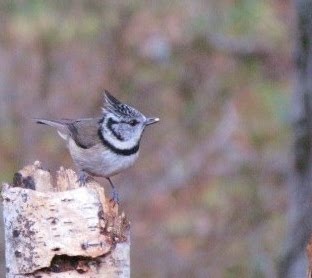
Crested Tits were seen regularly at forest feeding stations, giving good close range photo opportunities (see pic), along with dozens of Coal Tits, that are now so used to me, I can hand feed them with up to 3 on each hand at a time - a lovely interaction with nature!

Dippers continued to sing & perform well at dawn - some of my safari customers had seen Dippers before , & heard their distinctive 'zit' 'zit' calls, but none had ever heard their quite attractive, squeaky, scratchy song - often accompanied by a magnificent orange-pink sun rising over the River Spey - nice!

Mountainside species such as Ptarmigan & Mountain Hare were seen more frequently at lower levels as the tops became more snowy, and both were noted to be rapidly gaining their thicker, white winter coats.

Black Grouse numbers were seen to be increasing at or near traditional 'lek' sites, with up to 6 males being noted on some colder mornings.

The cock Red Grouse were also getting notably more showy & aggressive on the moors, as they start to try & establish territories ready for the breeding season.

The mixed Finch & Bunting flocks were seen to grow even larger on local farmland, with Bramblings now included in their ranks

Waxwings were also reported to be trickling into our area from the North & East, though not in the huge numbers of last year.