Highland Wildlife and Birdwatch Safaris, Guided wildlife excursions, Aviemore, Scotland
Highland Wildlife and Birdwatch Safaris, Guided wildlife excursions, Aviemore, Scotland Highland Wildlife and Birdwatch Safaris, Guided wildlife excursions, Aviemore, Scotland

Tuesday, June 30, 2015

June 2015 was certainly unseasonably cool and changeable weather-wise in this area, with the first week even seeing some overnight frosts and fresh snow on the higher peaks! However, there were enough decent days for it turn out to be another excellent month for wildlife sightings, and with around 20 hours of usable daylight and all of our summer visiting bird species on territory, bird day-lists are at their highest now, with full-day (12 hour) multi-habitat safaris regularly producing over 60 species, whilst mammal day-lists ranged between 5 and 9 species depending on the variety of habitats visited, with early starts proving most productive.
Just about every bird species seems to have youngsters now, though I fear the cold weather early in the month may well have adversely affected brood survival rates for some vulnerable species.
The combination of sun and rain helped to maintain the lush, green appearance of the spectacular highland scenery, with the wild flowers approaching their colourful best now, and a few more butterfly species were noted on the sunnier days.
I had some birding friends up from southern England mid-month, in search of all the 'Scottish specialities', so I have included a few highlights from our day-trip adventures, some of which were to locations beyond my Cairngorms National Park  'local patch'.....

Cairngorms moorland soon after dawn

Wildlife highlights included:

Local speciality and upland bird species seen regularly throughout the month included: DipperOsprey, Goldeneye, Crested Tit, Black Grouse (early in the month only), Red GrouseSlavonian Grebe, Red-Throated DiverBlack-Throated Diver, Short-Eared Owl, and Ring Ouzel
A couple of trips high up into the Cairngorms produced the classic 'mountain-top' species, Ptarmigan, Dotterel and Snow Bunting.....
We also enjoyed some good dawn views of Barn Owl and Tawny Owl, and a few decent sightings of Red KiteHen Harrier and Golden Eagle, a couple of brief glimpses of Scottish Crossbill, and one memorable fly-over by a White-Tailed Eagle, though sadly Capercaillie (not unusually) did not feature at all this month....

Mammals seen regularly locally during the month included: Red SquirrelRabbitBrown HareMountain Hare,  Roe DeerRed DeerReindeerMountain Goat, Bank Vole, the local upland speciality Black Water Vole,  a couple of sightings of Stoat, whilst a dusk 'stake-out' gave us a Pine Marten, and a couple of coastal excursions provided Dolphins, Seals and an Otter...

Osprey at nest
Osprey is probably the 'star bird' of the mid-summer months up here  - with my safari parties being fortunate enough to see them plunge-dive spectacularly to catch a fish, or delivering a fish to the nest on several occasions, and regular great views of the adult birds watching over their rapidly growing young in the nest...

Lekking Black Grouse
Our local Black Grouse continued to lek into June, with a pre-4am arrival giving us the opportunity to see the amazing 'Blackcock tango' for the last time this year.. often backed up by a 'supporting cast' of Short-Eared Owl and Barn Owl....

Red Grouse family (pic from June 2014)
Red Grouse were not too difficult to find on suitable areas of heather moorland, and if you could spot the heads of the adults above the heather, you then usually got to see their large families of fast-growing youngsters too...

Ring Ouzel by Norman Green
Ring Ouzels showed well in upland habitats near their nesting and feeding areas early in the month but became noticeably more elusive as the month progressed as they and their recently-fledged young began to roam further afield....

Crested Tit by Malcolm Fincham
Crested Tits actually became a little easier to see this month, as the family groups foraged together through our local Caledonian Pine Forests , though it should be noted that they really are very 'flitty', and you certainly need to know their distinctive song and calls in order to be able to find them....

Scottish Crossbill (pic from June 2014)
Crossbills as usual, were generally a bit elusive, though one day of serious 'forest bashing' mid-month eventually provided us with some half decent views...

Black-Throated Diver
Both Red-Throated Divers and Black-Throated Divers in their dapper summer plumage, were seen regularly on suitable secluded local lochs, the latter with young, though we generally had our best views on calmer days, with little or no ripple on the water, and early and late in the day, when human disturbance was it it's lowest....

Slavonian Grebes
Slavonian Grebes, also in their beautiful summer plumage, were seen and enjoyed regularly by my safari parties on their favoured quiet lochans, though rather worryingly we could not yet confirm any much-needed breeding success for this increasingly scarce species....

Golden Eagle is not usually an easy bird to see in the summer months, as they have so many hours of daylight in which to hunt. It is just a case of putting yourself in a likely upland glen , and hoping you get lucky... fortunately we did on several occasions, though most of the sightings were at quite long range...

It was a similar story with White -Tailed Eagle, though we got a real bonus on the 18th, when one of these huge raptors flew over our heads at unusually close range - a very memorable experience!

Ptarmigan by Malcolm Fincham
June is probably the best month to have a chance of seeing all 3 of our mountain top bird species, and although suitable days weather-wise were few and far between, a walk up and around Cairngorm summit on the 16th gave us decent views of Ptarmigan, Dotterel and Snow Bunting, though the low cloud prevented us from getting many really good photos...

Pied Flycatcher
Other good birds of note seen this month included Cuckoo, Golden PloverRedstart, Spotted Flycatcher, Pied Flycatcher and Wood Warbler, all of which can be tricky to see in large parts of the UK....

Icterine warbler by Bob Smith
We also had a rare  visitor this month, that is usually found much further east in Europe, in the form of an Icterine Warbler. This is obviously not a common bird in this area, and attracted a minor 'twitch', including myself and a few friends, and although it was typically difficult to see in the well leafed treetops, by following it's distinctive song, we did manage a few decent views...


Puffin on Handa Island
June is also probably the best month in which to visit a coastal seabird colony, so taking advantage of a favourable weather forecast, the 15th saw us take a day trip up to the north-west coast to the wonderfully remote and beautiful  Handa Island. Even the short ferry crossing from Tarbet gave us super close-up views of Seals, Black Guillemot and Red-Throated Diver, and once on the island, after our welcome talk by the SWT wardens, we went on to see  Snipe, Red Grouse, Wheatears, Skylarks, and Arctic and Great Skuas galore nesting on the moors. Once at the impressively high cliffs and coastal stacks, we were treated to the unique sights, sounds (and smells!) of good numbers of  Fulmars, Kittiwakes, Razorbills, Guillemots, and yes, everybody's favourite - Puffins!

Onto mammals now....


Red Squirrel
Our local Red Squirrels, a species sadly absent from much of the UK now, are always popular with my safari clients, and visits to my favourite Caledonian forest sites gave us lots of good sightings, often with decent photographic opportunities....

Red Deer by Norman Green
Deer are always popular too, and early starts and a variety of habitats visited, gave us the chance of up to 4 different species......

Feral Mountain Goat

Being absent from much of the UK, and only really found in remote upland areas, feral 'Mountain' Goats are a good mammal 'tick' for my safari clients, and we managed to see them on many of my safaris....

Bottlenose Dolphin by Bob Smith
Dolphins are always high on most people's mammal wish-list when visiting coastal areas, and we are lucky to have probably the best land-based site in the UK nearby at Chanonry Point on the Black Isle, north of Inverness. A visit at the right stage of the tide on the 20th gave us superb close-up views of these entertaining and charismatic animals hunting the Salmon returning upriver to spawn...

So, despite the changeable weather, it looks like June 2015 can go down as yet another great month for wildlife-watching in and around the Cairngorms National Park, with the wide range of habitats visited producing a splendid variety of birds and animals, and all in wonderfully scenic surroundings.....

Spectacular Highlands scenery

Sunday, May 31, 2015


May 2015 will, I suspect, go down as one of this area's coldest May's on record, with temperatures well below the average, regular overnight frosts, occasional snowfall on the mountains, and some very changeable weather.
However, despite the 'challenging' conditions, we managed to get out and enjoy lots of very successful safaris, and with over 18 hours of usable daylight now and all of our breeding species arrived, full-day bird lists crept up into the 50's or even low 60's, whilst mammal species day-lists varied between 6 and 10 depending on our luck and the variety of habitats visited, with early starts giving us noticeably more and better views. The combination of sun and precipitation has at least given the landscape a beautifully fresh green glow, with the wild flowers and first (brave!) butterflies adding a welcome splash of spring colour.
The unseasonably cold weather over the last few weeks seemed to have an impact on our local breeding birds though, with many delaying nesting, and our first fledgling sightings being noticeably later than last year.


Glenmore Forest and Cairngorm Mountains soon after dawn


Wildlife highlights included:

Local speciality and upland bird species seen regularly throughout the month included: DipperOsprey,  Black Grouse, Red GrouseSlavonian Grebe, Red-Throated DiverBlack-Throated Diver, Short-Eared Owl, and Ring Ouzel. We also enjoyed another chance dawn encounter with a Capercaillie , just a few decent sightings of Crested Tits and Crossbills...a couple of brief views each of Goshawk and Hen Harrier.... and the late snow gave us another welcome chance to view Snow Buntings at lower levels....and although I have not yet been up the mountains in search of them, I understand our Dotterel are now back, and on the few calm days, the Ptarmigan have been showing well too....


Mammals seen regularly during the month included: Red SquirrelRabbitBrown HareMountain Hare (now a mottled blue-grey) Roe DeerRed DeerReindeerMountain Goat and Bank Vole,  a couple of sightings of Stoat, and one of Seals at the coast...........but 'mammal of the month' was undoubtedly the (incredibly rare and sought-after) Scottish Wildcat seen stalking Rabbits just before dawn on May 10th - an unforgettable experience!!!!

Lekking Black grouse

Black Grouse 'lekking' is surely one of British wildlife's top 10 sights (and sounds), and our local birds continued to 'lek' throughout the month, with up to 10 cock birds fighting it out, occasionally with a few females 'spectating',  though with dawn at around 4:30am, and the performance only lasting for around 90 minutes on average, it should be noted that a very early start is needed if you want to see them...and that we have to view from a respectful distance....(I took the above unusually close-up pic from a hide).....but this is still a highly recommended and memorable experience, especially as on several occasions, we had a supporting cast of Short-Eared Owls and Barn Owls hunting across the moors close to the lek site!!!

Osprey with fish

Our local Ospreys continued to entertain my safari clients, and although the female birds spent much of the month deep in their nests incubating eggs, we occasionally witnessed the male birds 'plunge-diving', delivering fish and more nest-building materials, and witnessed flights overhead on many occasions - impressive stuff!!

Ring Ouzel

Ring Ouzels were seen regularly in their upland habitat, though they are no longer singing, and sightings were mainly restricted to male birds collecting worms, as the females were presumably on nests.....


Slavonian (Horned) Grebe
The extremely beautiful (and incredibly rare) Slavonian Grebes were again seen and enjoyed regularly on suitably quiet local lochs, with the male birds seen fishing and delivering food to the nests hidden in the bankside sedge beds.....

Red-Throated Divers
Both Red-Throated and Black-Throated Divers too, are only really found breeding, and in their dapper summer plumage, on suitable lochs in northern Scotland. Due to their general shyness, most views we get are at a fair distance, but occasionally, usually early in the morning, we get lucky and obtain a slightly closer look.. 


Snow Bunting

Usually by May, you have to trek up near Cairngorm summit to see Snow Buntings, but the unseasonable snow at low levels this year meant that they continued to show in and around the ski centre car park early in the month - good news for my safari clients and I......

Red Grouse

On our local heather moorlands, the cock Red Grouse continued to show well, with some still calling and displaying, and late in the month we began to see the hen birds with their newly fledged families of up to 7 very cute fluffy youngsters...

Young Goldeneyes (pic by Bob Smith)

In fact, fledglings of many species were seen late in the month , including Goldeneye and Lapwing, whose youngsters must be among the cutest out there........


Young Lapwing


Golden Plover (pic by Jan Shields)


Other good birds of note seen this month included Cuckoo, Golden PloverRedstart, Spotted Flycatcher and Wood Warbler, all of which can be tricky to see in large parts of the UK....


King Eider (pic by Bob Smith)

I don't often go on a 'twitch' outside of the Cairngorms National Park in search of rare birds, but on May 22nd, when my Rare Bird Alert pager informed me that the Aberdeen area had both a Harlequin Duck and a King Eider showing, a trip to the east coast (about 90 miles away) was quickly planned. Sadly, the (very enjoyable) walk up and down the River Don in pursuit of the Harlequin Duck proved fruitless, and it has not been seen since! However,the search for the King Eider at Newburgh on the Ythan estuary was thankfully more successful....

Onto mammals now....

Red Squirrel

Our local Red Squirrels are always popular with my safari clients, and visits to favourite Caledonian forest sites gave us lots of good sightings, often with decent photographic opportunities....


Red Deer Stag

It's always nice to see Deer too, and early starts and a variety of habitats on the itinerary can give us the chance of seeing up to 4 different species.....

Stoat (pic by Bob Smith)

Stoat is an animal that you usually only get a very fleeting glimpse of, often in hot pursuit of a Rabbit, but fellow wildlife enthusiast Bob Smith took advantage of one very pre-occupied individual showing well mid-month, to get this super pic....


This month was actually so good for sightings and photos that my report could have easily been double this length!, so I have tried to just stick to subjects that are 'local specialities' or most representative of a typical safari at this time of year, with just a few of the more common or random 'wild-card' occurrences.....
I hope you have enjoyed reading it as much as I have enjoyed experiencing it......

A golden dawn over a Cairngorms moorland


Thursday, April 30, 2015

April 2015 was a bit 'back to front' weather-wise in this area! The month started off warm and sunny, fooling us all into thinking Spring had arrived, but then got progressively cooler, finishing up with a wintry blast of snow and sub-zero temperatures more akin to February!
However, with 16 hours of daylight now, the scenery ablaze with colourful spring flowers and blossom, and many bird species displaying and singing,  you probably will not be surprised to read that I consider this to be one of the best, and my personal favourite time of year for wildlife watching.
The vast majority of our remaining winter visiting birds departed by mid - month, whilst summer visiting birds poured in throughout, helped by the frequent southerly winds.
Bird species day-lists regularly crept well up towards 50 on full-day multi-habitat safaris, whilst mammal day-lists varied between 5 and 9 depending on our luck.

Cairngorm Mountains and moorland at dawn

Wildlife highlights included:

Local speciality and upland bird species seen regularly throughout the month included: Dipper, Osprey, Crested Tit, Black Grouse, Red Grouse, Slavonian Grebe, Red-Throated Diver, Black-Throated Diver and Ring Ouzel, we also enjoyed a couple of chance dawn encounters with Capercaillie our first decent sightings this year of Crossbills... and the late snow gave us another chance to view  Snow Buntings at lower levels....

Mammals seen regularly during the month included: Red SquirrelRabbit, Brown Hare, Mountain Hare ( now mottled white and blue-grey) Roe Deer, Red Deer, Reindeer, Bank Vole and Mountain Goat, a couple of sightings of Stoat, and a solitary view of a small group of Sika Deer....

Ospreys at their nest

One of my favourite wildlife moments every year, is the return of our local Ospreys to their nesting sites.These beautiful and impressive birds of prey provide great entertainment, with their dashing good looks, aerial acrobatics and plunge-diving to catch fish. My favourite local pair were reunited early in the month after a winter apart in West Africa, and were soon seen building up the nest, mating frequently, and by the end of the month appeared to be incubating eggs, as the hen bird seemed to be spending the vast majority of the day in the nest, with the cock bird now seemingly performing all of the fishing duties.

'lekking' Black Grouse

Dawn (now around 5am) visits to local Black Grouse leks continued to enthral and amaze my safari clients, with as many as 12 males seen 'performing', and, on the 10th , we were very lucky to be present when 4 hen birds arrived to watch the action, and some were even seen mating with their chosen, dominant cock birds - a fantastic wildlife spectacle, and a great way to start the day! 

Ring Ouzel

Ring Ouzel features on the 'wish-list' of many of my safari clients, probably because they tend to breed in remote, upland areas far from human disturbance and can be quite tricky to find. We are fortunate in having plenty of suitable habitat for them in this area, and we managed to get decent views on several occasions... 


Crested Tits generally become more difficult to see as spring progresses, as they become much more secretive, calling less and concentrating more on quietly breeding than visiting forest feeding stations. However, with a little persistence, we did manage to see them on a number of occasions, though it should be noted that recognizing their distinctive calls and song is a must if you are to have any chance.....

Slavonian (Horned) Grebe

Slavonian (or Horned) Grebe is not only one of the UK's rarest breeding birds, nesting only in the very north of Scotland, but, in summer plumage, surely one of our most beautiful - with its chestnut, black and copper toned body, scarlet eyes and amazing golden crest tufts it is sure to put a smile on most birders faces...and we are fortunate enough to have a few pairs on one or two suitable local lochs....lucky us!

Black-Throated Diver

Also on our local lochs, we were able to get decent views of two other very rare and beautifully marked birds, in the form of Red-Throated Diver and Black-Throated Diver, though I have yet to get any decent photos (the rather poor effort above being my best effort so far this year) as they usually seem to like to keep a fair distance from humans...

Drake Goldeneye

Still on the lochs, dapper drake Goldeneyes  continued to call and perform their elaborate courtship displays, though with many of the females now on eggs, their audience is becoming noticeably smaller...

Cock Red Grouse

Our local moorlands continued to echo with the guttural calls of the cock Red Grouse , who were still actively displaying from prominent positions, but from mid month we saw very few hen birds, suggesting that many may already be incubating eggs......

Dipper with nesting material

Our local rivers support good numbers of Dippers, and we should see youngsters soon as we witnessed nest building early month, and later in the month the adult birds collecting beak fulls of insects, before returning to their nest sites...


Pair of Crossbills - Don't worry, it's not your eyes - just a rubbish photo!

As I have mentioned in previous reports, Crossbills are probably one of the most difficult of our local speciality birds to get a good view of. However, this month we did actually manage a few decent sightings, sometimes of whole families of these very attractive birds, usually feeding from cones near the tops of conifer trees, though the only (very poor) photo I managed (in my defence- through the windscreen with my mobile phone camera) was of a pair drinking from a trackside puddle...

The very same piece of track also gave us a couple of brief post-dawn sightings of female Capercaillie taking grit.... though on both occasions, sadly, they flew off before we had a chance to get any photos.....

Snow Bunting

Although we did not go on any mountain top adventures for Ptarmigan and Snow Bunting this month, we got lucky with a sighting of a small group of the latter frequenting the Cairngorm Ski Centre car park when the snow returned to lower levels at the end of the month...


Short-Eared Owl

Other good birds of note seen this month included a beautiful Short Eared Owl seen hunting low over a local heather moorland, which rather fortuitously for me, then perched on a large rock for a short while, giving me the chance to grab a couple of photos...


Common Sandpiper

As well as the aforementioned Ospreys and Ring Ouzels, other returning migrant birds seen this month for the first time this year included Sand Martin, Swallow, House Martin, Willow Warbler, Wheatear, Common Sandpiper and Redstart.....


Willow Warbler

Onto mammals now........

Mountain Hare


Our local Mountain Hares, though they are rapidly morphing their beautiful all-white winter coats into their blue-grey spring outfits,  again proved popular with my safari clients, presumably because they are confined to upland areas of the UK, and are not easily accessible to most wildlife watchers.

Red Squirrel

Similarly, Red Squirrels are always a treat to see, and forest feeding stations again proved to be our best bet for a sighting.....

Roe Deer


It's always nice to see Deer too, and early starts and a variety of habitats on the itinerary can give us the chance of seeing up to 4 different species.....

Red Deer stag
Moray Firth Dolphin

Dolphins are always high on most people's mammal wish-list when visiting coastal areas, and we are very lucky to have probably the best land-based site in the UK nearby (about a 60 minute drive from Aviemore) at Chanonry Point on the Black Isle, north of Inverness. A visit at the right stage of the tide on the 9th gave  us superb close-up views of these entertaining and charismatic animals... (see pic above)
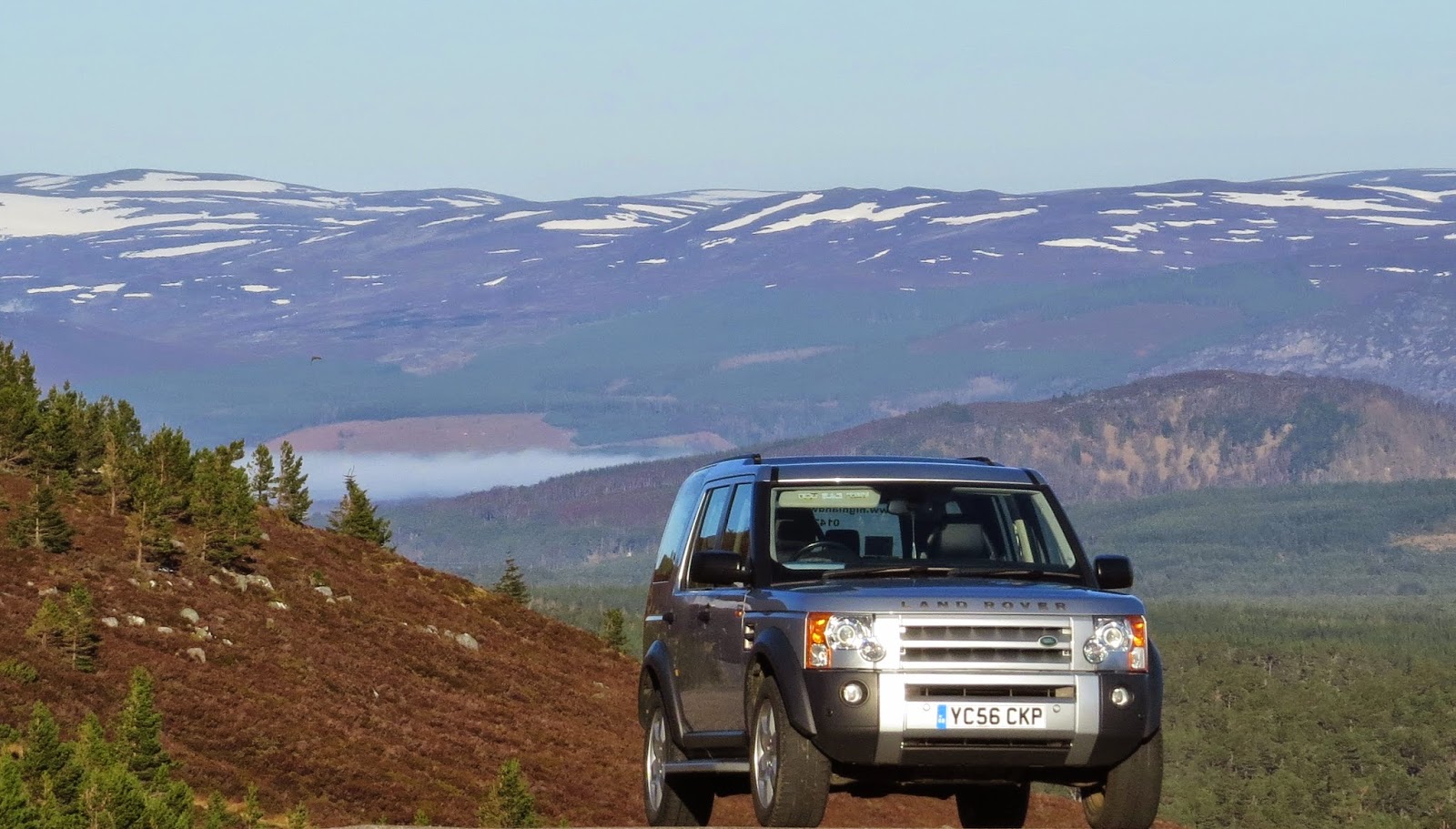
My trusty Land Rover Discovery out on safari

So to sum-up, April 2015 was a really excellent and very enjoyable month for wildlife watching in the Cairngorms National Park. With the returning summer-visiting birds flooding northwards to join our resident species, the days lengthening, flowers blooming, the stunning scenery and the weather (generally) improving, I can honestly say I would not want to be anywhere else in the world than here at this time of year.....

Sunrise at Loch Morlich