Highland Wildlife and Birdwatch Safaris, Guided wildlife excursions, Aviemore, Scotland
Highland Wildlife and Birdwatch Safaris, Guided wildlife excursions, Aviemore, Scotland Highland Wildlife and Birdwatch Safaris, Guided wildlife excursions, Aviemore, Scotland

Friday, January 06, 2017

Merry Christmas!! I would like to wish a happy and wildlife-filled new year to all my readers!
And a big "thank you" to everyone who used and supported my safari guiding services during 2016......

December 2016 was a very strange month weather-wise in this area! We started off, as is quite usual this far north, with northerly winds and a really cold feel (down to -9c), but then, rather unexpectedly, mild south-westerly winds began to dominate,the weather turned cloudy and damp, and temperatures began to climb, and remained well above average for the rest of the month, and we even had our warmest ever (14c) December day! So, though it was not particularly 'festive' weather, and not so good for scenic photography,  it was actually pretty decent for wildlife watching!
Despite the days being at their shortest now, with only around 7-8 hours of daylight, we still enjoyed some memorable wildlife adventures, with plenty of memorable wildlife sightings often against dramatic Highland backdrops.
With all our winter-visiting birds now here, full-day safari bird lists topped-out in the 40's, whilst mammal day lists varied between 5 and 8 depending on the time of our start and number of habitats visited.
I was away down in England visiting relatives and friends for the final third of the month, so my report is a little shorter than usual, but to give you an idea of what you may realistically hope to see if you are planning a future December visit, I hope the following more detailed information, illustrated with photos taken by myself or my safari clients will help, clicking on the picture will enlarge it to full screen.

An Eagles eye view of a favourite local glen 

Wildlife highlights included:

Local speciality/upland bird species seen regularly during the month included:
Black Grouse, Red Grouse, Crested Tit, Dipper and Golden Eagle, and we also had a few decent sightings of Crossbill and Snow Bunting. Winter visiting birds were represented by family groups of Whooper Swans, several species of 'grey' Geese, large numbers of Redwings and Fieldfares, whilst literally hundreds of Waxwings continued to feast on berries throughout the month...a small flock of Hawfinches lingered, though they did become a little more mobile..and a few more Bramblings and Redpolls were seen...... 

Mammals seen regularly during the month included:
Red Deer,  Roe Deer, Reindeer, Red Squirrel,  Rabbit, Mountain Hare and Mountain Goat, with  just a couple of sightings of Brown Hare, and one brief glimpse of a Stoat. 

Pre-dawn starts - a relatively user friendly 7am at this time of year - gave us decent views of Black Grouse on local moorland 'lek' sites, though the birds did not seem to be quite so 'up for it' on the milder mornings, with more birds and more 'action' being seen on the colder days....

Male Red Grouse by safari client Tom Southall
By way of contrast, our local Red Grouse were actually surprisingly easy to see and photograph on their favoured upland heather moorlands this month, as many of the cock birds seem to be getting a bit territorial, with some seen perching prominently on the few higher points and occasionally even being heard uttering their guttural 'go-back, go back' calls...

Crested Tit by safari client Tom Southall
Our local Crested Tits continued to show well at my favourite forest feeding stations, especially soon after dawn, and on the colder days, when they are presumably at their hungriest. There are probably only around 1,200 - 1,500 of these charismatic little birds in the whole of the UK, and they are all to be found in the Caledonian forests of Highland Scotland, so you can imagine that many of my safari clients are delighted to see them, especially if it is a 'life-tick'.

Dipper

Our local Dippers appear to already be planning for the spring breeding season, with much singing and displaying being witnessed , especially soon after dawn, and near to favoured nesting spots such as bridges....which is handy , as it gives us much more chance to see and photograph them....

Golden Eagle

As I mentioned last month...the short daylight hours mean that early to mid-winter is definitely the best time of year for raptor sightings in this area, and this month again proved very fruitful, with my favourite local upland glens providing my safari clients and I with regular sightings, and even the occasional (and rare)  photo opportunity, of the much sought after Golden Eagle, with views of these magnificent and iconic birds providing great entertainment,  numerous 'life-ticks'  and putting big smiles on many faces....The regular 'raptor back-up cast' of Kestrel, Sparrowhawk, Peregrine, Buzzard , Red Kite, and even the occasional Hen Harrier and Goshawk, should not be forgotten though, as all were seen at least once.....


Male Crossbill

Being early breeders, Crossbills actually become (thankfully!!) a little easier to see in midwinter, as the male birds can occasionally be heard singing (rather than just calling) from the tops of conifers, in an attempt to establish a territory and attract a mate...


Snow Bunting by Steve Nicklin

Snow Buntings could be seen at lower levels early in the month whilst it was cold and snowy, but became much more difficult as the snow receded in the unseasonably mild temperatures, and they presumably followed the snow-line uphill......


Waxwing by Steve Nicklin

Those colourful 'viking invaders', the Waxwings, continued to chomp their way through local berry supplies, providing great entertainment and giving us more opportunities to capture images of these beautifully marked birds...


Hawfinch
Hawfinches are extremely rare on Speyside, and the small flock that arrived last month seemed to become much more mobile, and occasionally split up into smaller groups, so I thought I had better grab the opportunity of a few more pics, before they inevitably depart....


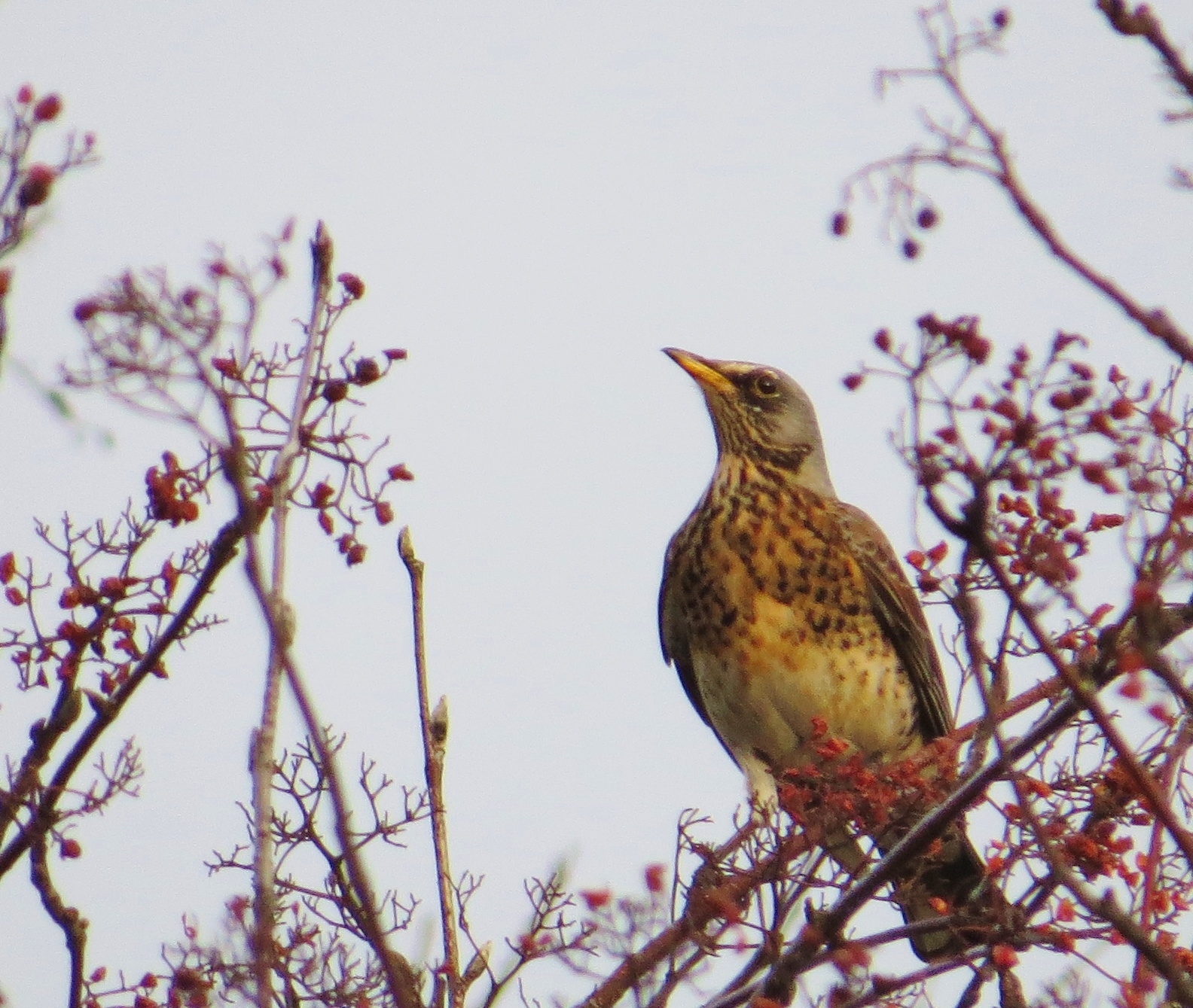
Fieldfare
Whooper Swan and Geese numbers seemed to decrease a little in this area, as many of the birds presumably headed further south, but  Redwing and Fieldfare numbers seemed to remain high, and it was interesting to watch our 'local' Blackbirds trying (usually in vain) to defend 'their' berry bushes from the unwelcome intruders...

Onto mammals now...


An anxious looking Mountain Hare... with good reason... a Golden Eagle was overhead!
Mountain Hares , now they are almost completely 'winter white' are often voted as 'mammal of the day' by my safari clients, at this time of year, and we were fortunate enough to see them in their upland habitats on a number of occasions. It should be noted though, that a bit of rough uphill walking is often required for photography purposes..

Red Deer stag

Though our Red Deer stags still have their magnificent antlers intact, but with rutting season long forgotten, they are much calmer beasts now, and are seemingly content to just quietly graze and laze around...

Red Squirrel

Red Squirrels, being absent from most of the UK now,  always prove popular with my safari clients, especially with those seeing one for the first time, and it is unusual for us not to see at least one whilst out on safari....

Well, another year has flashed by, fortunately for me it was one filled with beautiful highland scenery, lots of amazing and memorable wildlife, and happy times spent with lots of interesting people from all over the world. I hope you have enjoyed reading my safari updates as much as I have whilst experiencing and writing about them.....And I am already looking forward to even more wildlife-filled adventures in 2017...

Add caption

If you think you know someone who may enjoy a taste of what I do, why not treat them to a safari gift certificate. They make a great present and are available for any amount in multiples of £10, and are valid at any time within a year from date of purchase....

Early morning at Loch Garten

Wednesday, November 30, 2016

November 2016, despite being colder and snowier than average, was actually quite user-friendly for wildlife watching in this area. With high pressure largely dominant, we enjoyed plenty of cold but dry and sunny days, with light winds and clear skies - ideal for safaris. Add in the last of the autumn colours and some dramatic snow-capped winter landscapes, and a good time was had by all.
Though the days are shortening noticeably now, with only around 8-9 hours of usable daylight, a further influx of winter-visiting birds from further north, including a few rarities,  helped to boost full-day bird day-lists into the low 40's, whilst mammal day-lists varied between 4 and 8 species, depending on the time of our start, and variety of habitats visited.

All photos shown were taken by either myself or my safari clients, and clicking on the picture will enlarge it to full screen.

Winter in a favourite local upland glen

Wildlife highlights included:

Local speciality/upland bird species seen regularly during the month included:
Black Grouse, Red Grouse, Crested Tit, Dipper, Golden Eagle, and White-Tailed Eagle, and we also had a few sightings of Crossbill and Snow Bunting. Winter visiting birds were represented by Whooper Swans, several species of 'grey' Geese, Redwings and Fieldfares, whilst literally hundreds of Waxwings were seen feasting on berries throughout the month...a small flock of Hawfinches were a good local 'tick', the first Bramblings were seen, and even a couple of scarce Yellow-Browed Warblers and an incredibly rare Siberian Accentor were reported nearby.....

Mammals seen regularly during the month included:
Red Deer,  Roe Deer, Reindeer, Red Squirrel,  Rabbit, Mountain Hare and Mountain Goat, with  just a couple of sightings of Brown Hare. The first half of the month also saw us enjoy great views of Atlantic Salmon continuing to spawn in the upper reaches of our local rivers....

Black Grouse
Black Grouse are always popular with my safari clients, probably because of their relative rarity and sadly, declining numbers over much of the UK, However, we are fortunate to have steady numbers in Highland Scotland, and our dawn visits to their traditional local moorland 'lek' sites were usually fruitful, with a maximum of 9, and an average of 6 cock birds seen showing and displaying well this month, with cold, still, frosty mornings generally proving more successful than wet and windy ones. 

Red Grouse
Red Grouse too, being birds of very specific upland heather moorland habitat, are absent from much of the UK these days as well. Thankfully though, we have no shortage of them in this area, and it was interesting to note that once the snow arrived, they seemed to group up into 'super-flocks' often containing dozens of birds, rather than the more usual family sized parties.

Crested Tit by Ron Penn
As the weather turned colder and snowier, Crested Tits actually became less difficult to see, with the easy pickings on offer at my forest feeding stations, especially soon after dawn, seemingly proving to be almost irresistible. It was a great feeling to show off these true 'Speyside specialities' to my safari clients, especially those who were seeing them for the very first time.

Dipper
Our local Dippers are definitely becoming more aggressive now, with much displaying, dawn singing and chasing each other around being witnessed as they presumably seek to establish winter and breeding territories, and it still makes me shiver every time I see them disappear under the icy water in search of food - they sure are tough little critters!

Golden Eagle or juvenile White-Tailed Eagle? by Ron Penn.. you decide...
As I have mentioned in previous years, and with no apologies for repeating myself... November is in my opinion, THE month for raptor sightings in this area, and so it proved again this year, with my favourite local upland glens providing my safari clients and I with pleasingly regular sightings, and even the odd (very rare)  photo opportunity, of the much coveted Golden Eagle and White -Tailed Eagle, with these awesome and majestic 'Kings of the skies' providing great entertainment, numerous 'life-ticks'  and putting big smiles on many faces....
The regular 'raptor back-up cast' of Kestrel, Sparrowhawk, Peregrine, Buzzard , Red Kite, and even the occasional Hen Harrier and Goshawk, should not be forgotten though....

Male Crossbill
Crossbills again proved to be  a bit frustrating, with sightings generally being limited to fleeting glimpses of fly-over birds, their 'jip jip' calls alerting us as to their identity. However, on the 27th , we finally got lucky, when a male bird perched and called from a conifer briefly, giving us super views and a very rare photo opportunity.

Snow Bunting by Steve Nicklin
Snow Buntings became a lot easier to see than normal, as they began to frequent known lower altitude sites, no doubt driven down from the mountain tops by the snow, and with their numbers likely to have been swelled by visitors from Scandinavia...

Waxwings
Our local Waxwing flocks continued to grow, with one peaking at around 400 birds! Though they could be frustratingly mobile and elusive, as they work their way through our local berry supplies! By staking out known 'hot-spots' though, I managed to grab a few decent photos....

Hawfinch
Hawfinch is a very uncommon (much less than annual) bird on Speyside, so I was certainly not going to turn down the chance of 'twitching' a flock reported in Larch trees and scrubby bushes near the River Spey at Grantown toward the end of the month. Though they rarely showed clearly for me, I did manage to grab a few reasonable shots..

Onto mammals now....


Mountain Hare
Mountain Hares , now they are turning 'winter white' often feature on my safari clients wish-lists at this time of year, and we were fortunate enough to see them in their snowy upland habitats on a number of occasions. It should be noted though, that a bit of rough uphill walking is likely be required for photography purposes..

Red Deer stag
Although the autumn 'rut' is now over and seemingly already forgotten by the participants!, it was still a treat to see the magnificent fully antlered Red Deer stags now largely back in their same-sex herds in their favoured upland glens, often above the snow-line, with close-up views often leaving my safari clients surprised at their impressive size and powerful build....


Roe Deer
Roe Deer, whilst not quite as impressive as the Reds, are still nice to see, though they can be a little crepuscular, rarely showing well outside of the low-light times of dawn and dusk, and they are generally pretty wary of human disturbance.....so you need to be quick with your camera!


Red Squirrel by Wendy Ball
Red Squirrel is often on my safari clients 'wish-list', being sadly absent from much of the UK now, and I am pleased to say that we had a very good success rate with sightings of these endearing little animals this month, who seemed to spend much of the month hiding and burying nuts ready for the hard times of winter.... 


Atlantic Salmon
November is usually the best month of the year to see our Atlantic Salmon spawning. These remarkable and often very large fish spawn in the shallow waters in the upper reaches of our rivers, at the very spot where they themselves were hatched several years before, having originally spent 2-3 years in the river, then another 2-3 years feeding, growing and maturing out in the mid Atlantic, before undertaking a perilous journey many miles upriver, often involving avoiding poachers and predators and negotiating high falls and rapids on the way - an amazing migration story! However, sightings are very reliant on the rivers water levels - too little water and the Salmon cannot access the upper reaches - too much water, and they can get there... but we can't see them. As I mentioned last month though, this autumn we got lucky with everything falling into place, and good sightings being enjoyed up until the third week of this month..


When the going gets tough........thank goodness for 4-wheel drive! 
So, although many people that I know seem to get the 'winter-blues' as the days shorten and the temperatures drop , as a keen wildlife watcher, it is far from the case for me up here, with November now one of my favourite and, weather permitting of course, most productive safari months, with lots of great wildlife to be enjoyed, some of the 'local speciality species' at their easiest to see, and all in spectacular and often snowy scenery.....


Cairngorm Mountains - viewed from Nethy Bridge

Monday, October 31, 2016

October 2016 was a very good month for wildlife-watching in this area weather-wise. With high pressure and, unusually, easterly winds dominating for most of the month, we enjoyed lots of calm and sunny, if occasionally a bit chilly weather, with very little rain throughout the month.
Though the days are certainly shortening now, we still had around 10 hours of usable daylight, and the Highland scenery is still ablaze with glorious autumn colours, with most leaves still clinging on, the berry-bearing trees fully laden, and the first dustings of snow on the Cairngorms providing many of my safari clients and myself with some very picturesque landscape photo opportunities.
October is a great month to witness visible migration in action, with large flocks of Geese, Swans and Thrush species often witnessed flying noisily overhead, and this influx of winter visitors from colder areas further north, helped full-day safari bird lists increase up into the 40's, whilst mammal day-lists varied between 4 and 9 depending on the start time and number of venues visited.

Autumn at Insh Marshes

Wildlife highlights included:

Local speciality/upland bird species seen regularly during the month included:
Black Grouse, Red Grouse, Crested Tit, Golden Eagle, White-Tailed Eagle, and Dipper, we also had a few glimpses of Crossbill, and a solitary sighting of Hen Harrier. Whilst a mountain-top adventure also gave us great views of Ptarmigan...and winter visiting birds were represented by Whooper Swans, several species of 'grey' Geese, Redwings and Fieldfares,  a few Waxwings were seen feasting on berries at the end of the month...and even a couple of Yellow-Browed Warblers and a Snow Goose were reported nearby.....

Mammals seen regularly during the month included:
Red Deer (rutting), Roe Deer, Reindeer, Red Squirrel, Rabbit, and Mountain Goat, with just a few sightings of Brown Hare and Mountain Hare, and just one brief glimpse of a Stoat. The last week of the month also saw us enjoy great views of Atlantic Salmon spawning in the upper reaches of local rivers....
And a day on Mull produced Otter, Porpoises and Dolphins.....

Black Grouse
The cock Black Grouse on our traditional moorland 'lek' sites, having largely been missing since early June, began to assemble and occasionally even display at dawn, especially on the colder mornings, with my safari clients and I seeing up to 6 birds at once, although the (still summer length) long grass made viewing quite tricky at times....
Red Grouse (female)
Our local Red Grouse appeared to still be in their (sadly now smaller) family groups, and with the shooting season virtually over, they seem a little less wary and can be a bit easier to see, especially when using my safari vehicle as a slow-moving mobile hide on the quiet tracks through their heather moorland home.
Crested Tit
Crested Tits, having been generally 'uncooperative' through the summer months, began to become more regular visitors to forest feeding stations, especially soon after dawn, and we were fortunate enough to enjoy some decent and often close views of this true 'local speciality' on a number of occasions....
A bonus by-product of regular winter feeding is sometimes (on colder days) being able to feed the incredibly confiding Coal Tits and (sometimes) Great Tits by hand, an experience much enjoyed by my safari clients...

Crossbills, sadly, but not unusually, were somewhat less obliging however, with our views being almost totally restricted to snatched glimpses of birds flying overhead...identified mainly by their distinctive 'jip- jip' calls....

Golden Eagle
Golden Eagle is truly an iconic bird of the Scottish Highlands, and our regular visits to my favourite upland glen paid off on numerous occasions, with a number of very decent sightings, and a couple of very memorable close-up views of these majestic (and huge!) raptors being obtained.

White-Tailed Eagle
The same glen also gave us a couple of sightings of the even larger White-Tailed Eagle , with one particularly obliging juvenile bird giving us a splendid close-range fly-past, after a brief aerial battle with a Hen Harrier! on the 20th of the month, and it being a fairly slow flyer, I even managed to grab a couple of photos...
The shorter days of the winter months actually seem to give us more chance of seeing Eagles, as they have less available hours of daylight hunting time....

The same seems to apply to the other birds of prey too, with Common Buzzard, Kestrel, Sparrowhawk, Peregrine, Red Kite, and even Goshawk and Hen Harrier all being seen on my safaris this month.

Dipper by safari client Andy Jackson
Dipper is a bird absent from large areas of Britain, preferring clear, fast-flowing upland rivers over murky, slow-flowing lowland waterways. Fortunately, it is a fairly common sighting in this area, often perching prominently on a rock, and always proves popular with my safari clients ...

Ptarmigan
A walk up towards the summit of Cairngorm mountain mid-month, braving sub-zero temperatures , low cloud, and winds gusting to 63mph gave us great, but hard-earned views of over 30 Ptarmigan, in various states of plumage, with a few almost completely white now...

Newly-arrived Greylag Geese and Whooper Swans
The Moray coast is only about an hours drive north west of Aviemore, and a couple of trips to favourite reserves, bays and harbours gave good views of incoming winter migrants such as Greylag Geese, Barnacle Geese, Pink-Footed Geese, Brent Geese,Whooper Swan, Wigeon, Teal, Pintail,  Bar-Tailed Godwit, Knot, Golden Plover and Grey Plover.... and scarcer birds such as Snow Goose, Scaup and Green Sandpiper..


Fieldfares
Winter thrushes flooded into our area from their summer breeding areas further north and east, first the Redwings, followed soon after by the Fieldfares, and they soon set about pillaging our local berry supplies, much to the annoyance of our resident Blackbirds and Thrushes!


Waxwing
Waxwings arrived in our area late in the month, with several small flocks of these beautiful  'viking invaders' adding another splash of colour to the already impressive autumnal backdrop as they pillaged the berries from our trees and bushes, their confiding nature often allowing decent photo opportunities ....


Onto mammals now....
Red Deer stag by safari client Andy Jackson
'Mammal of the month' for October has to be the Red Deer,  with their spectacular annual 'rut' providing my safari clients with some superb entertainment - the fully antlered stags 'bolving' roars echoing through the glens, as they spend much of the month  posturing , fighting off rivals and attempting to mate with as many of their 'harem' as possible - surely one of British nature's 'must-see' experiences?
Roe Deer
Although not as physically impressive as their Red cousins, Roe Deer are probably more often described as cute, but always seem to prove popular with my safari clients, and we were fortunate enough to see them on numerous occasions this month, usually on marshland and woodland fringes, especially soon after dawn....


Red Squirrel
But, when it comes to cuteness..... our local Red Squirrels take some beating, as they again put smiles on many of my safari clients faces, especially those seeing these attractive and characterful little creatures for the first time...


Mountain Hare
Up in the glens, we had reasonably regular sightings of Mountain Hares (slowly morphing into their white winter coats) and feral Mountain Goats, though sadly, most of the views were at quite a distance, so really good photos eluded me this month.....


Spawning Atlantic Salmon
Atlantic Salmon continued to make their way up our local rivers towards their spawning grounds, though the lack of water definitely hampered their progress, until some rain late in the  month raised the levels enough to allow them access to some of the upper reaches, where we were then fortunate enough to be able to see them 'leaping' up falls, and also actually watch them spawning in the shallows..


My trusty Land Rover Discovery ready for action...

So, to summarise, helped by the decent weather, the annual Red Deer rut, and the miracle of migration, October 2016 turned out to be yet another very enjoyable month for wildlife watching in the Cairngorms National Park, with plenty of excellent sightings, many memorable experiences, lots of happy safari clients, and the odd surprise, all set against beautiful autumnal Highland backdrops.......


Autumn at Loch Insh