Highland Wildlife and Birdwatch Safaris, Guided wildlife excursions, Aviemore, Scotland
Highland Wildlife and Birdwatch Safaris, Guided wildlife excursions, Aviemore, Scotland Highland Wildlife and Birdwatch Safaris, Guided wildlife excursions, Aviemore, Scotland

Sunday, March 31, 2019

March 2019, with the exception of a short snowy spell mid-month, saw spring arrive unseasonably early in this area. Though with temperatures fluctuating wildly from -6c to +19c during the month, prospective visitors would be wise to keep an eye on the weather forecast, and bring a selection of clothes and footwear to suit all seasons and all weathers!

The days are lengthening nicely now though, with nearly 12 hours of usable daylight, and dawn (for the Black Grouse lek) is a still not too unsociable 6am, and with the Daffodils joining the Crocuses and Snowdrops, many birds now singing, Frogs and Toads on the move and Bumble Bees on the wing, I think it may now be safe to declare that winter is almost over....

With many of the winter visiting birds still here, and a few wader and water bird species returning to their inland breeding sites in the second half of the month, full-day safari bird species day-lists crept up over the 40 mark, though a trip to the nearby Moray Coast can boost this total considerably,  whilst mammal species day-lists varied between 3 and 8 depending on our luck, time of start, and the variety of habitats visited, with early starts usually proving most fruitful.

I was away down in southern England  visiting family and friends for part of the month, so my local sightings report will be a little shorter than usual and may include a few photos from previous March safaris that are representative of the month.


On safari in the snowy Cairngorm Mountains
To give you an idea of what you may realistically hope to see if you are planning a future March visit yourself,  I hope the following more detailed information, illustrated with photos taken in and around the Cairngorms National Park and nearby Moray coast, by myself , my friends or my safari clients will help - clicking on the picture will enlarge it to full screen.


Wildlife highlights included:

Local speciality/upland bird species seen regularly included  Black Grouse (dawn only) , Red Grouse, Crested Tit (early in the month and on colder days only), Snow Bunting, Goldeneye , Goosander, and Dipper, we also had  a couple of distant views of soaring Golden Eagle and one quite close sighting of  a White-Tailed Eagle,  and from mid-month, our first local reports this year of Red-Throated Diver, Black-Throated Diver and Golden Plover - all coming into their splendid summer breeding plumage - and at the very end of the month, our first Osprey, Slavonian Grebe and Ring Ouzels joined the ever-increasing numbers of other Summer visiting birds , such as Lapwing, Oystercatcher and Curlew.
And finally, at the 14th attempt!!, a dawn walk in Caledonian forest at last produced a (3 second) glimpse of a (male) Capercaillie for me....though my safari clients , sadly, have still to see one with me this year....
Although I personally did not go on any mountain top adventures for Ptarmigan this month, I understand that they could sometimes be seen well on the days when the weather was suitable....

Winter visiting birds were represented by a few remaining family groups of Whooper Swans, flocks of Greylag Geese and Pink-Footed Geese, wildfowl such as Wigeon and Teal,  a few (again annoyingly mobile) Waxwings continued to feast on our now almost totally depleted berries throughout the month..and a few Redwings , Fieldfares, Redpolls and Bramblings lingered....whilst the Great Grey Shrike (last reported in Feb) suddenly reappeared on the 25th!

A good variety of seabirds, waders,  wildfowl and Geese were enjoyed at the Moray Coast and the nearby inland lochs...


Mammals seen regularly locally during the month included:

Roe Deer,  Red Deer, Reindeer, Red Squirrel, Rabbit, Mountain Hare (still mainly white), and Mountain Goat (now with young), and a few sightings of Brown Hare ...

Common Seal and Grey Seal were both seen at the nearby Moray Coast...


March 2019 bird sightings in more detail:

Take your partners for the 'Blackcock tango'!!
Black Grouse are not an easy species to see in most of the UK now, mainly being birds of remote upland moors, preferably with forests and a grassy 'lekking' patch nearby, a very specific combination of habitats that is not so common nowadays. Fortunately, the Scottish Highlands still has a decent number of active  'lek' sites, where the cock birds gather to 'strut their stuff', and dawn (about 6 am in March) on my safaris in the first five months of the year is usually spent enjoying this memorable experience. 'Performances' were noticeably better on still, frosty mornings.... but please be aware that sightings are not guaranteed, and the birds can fail to show in very mild or wet and windy weather, or if disturbed by a predator or wandering sheep, cattle or horses....


Male Red Grouse
On the upland heather moorlands, our local Red Grouse have most definitely already paired-up, and the cock birds, with red 'eyebrows' aglow, seem to be concentrating more on defending their territory and partner from rival birds, often posturing aggressively from the higher parts of the moor whilst cackling loudly, and the 'disappearance' of some of the hen birds late in the month suggests that a few may already be on nests...


Crested Tit
In the Caledonian pine forests, Crested Tits were seen at and around my favourite feeding stations early in the month, giving several of my (often very excited) safari clients a much wanted 'life-tick', but after my return from down south, with the temperatures rising, they often failed to show during the latter part of the month, and when they did they didn't stay for long and rarely called, suggesting perhaps, that they are now concentrating on breeding rather than feeding.....
As I mentioned last month, it is well worth noting that the colder winter months (October-Feb) are actually the best time of year for seeing the 'wee Cresties', as these characterful little birds can be frustratingly secretive, unobtrusive and almost silent during the breeding season, with sightings being much more difficult to obtain between March and September....


Continuing the forest theme, sadly, it was back to 'business as usual' for our Crossbill sightings this month, as we were limited to very brief glimpses of birds flying over, with us only being able to identify them by their characteristic 'jip-jip' calls".....

Still in the forests, as I mentioned earlier, I finally got my first glimpse - all 3 or 4 seconds of it before it flew off - of a Capercaillie this month....a cracking male bird....though it has taken me 14 dedicated pre-dawn walks in secluded  areas where I have seen them in the past, to achieve this... and now we are into 'lekking' season, I will be 'responsible'  by staying out of 'sensitive' areas at dawn through April and May to allow this now very rare and declining bird to (hopefully) breed in peace....


Red-Throated Diver


Black-Throated Diver


Slavonian (horned) Grebe


It was better news on our local lochs though, as from mid-late month it was great to see the return of some of our rarest and in my opinion, most beautiful local speciality birds, namely Red-Throated Diver,  Black-Throated Diver and Slavonian Grebe. 
Speyside is at the south-westerly edge of the world-wide breeding range for these very sought-after species, and I am always very happy (and relieved) to see them back on their favourite waters....


Drake Goldeneye
Also on the lochs (and rivers), we must not forget our breeding Goldeneye population , and we were fortunate enough to see them regularly this month, with many of the males now performing their unique and spectacular 'head-banging' mating display!

Dipper
Dippers were seen frequently on local rivers this month, and they too seem to have procreation on their minds, as we are now (presumably) only seeing male birds, and they appear to be delivering nesting material to their mates and defending territory near their favourite nest sites of old bridges....

A very distant Golden Eagle hunting low over a ridge


Add caption

Common Buzzard


Peregrine Falcon


Red Kite


Kestrel


Male Sparrowhawk

As I have mentioned before, the shorter days of the winter months (Oct-Feb) give us our best chance of seeing Golden Eagles and White-Tailed Eagles although as the days lengthen, the frequency of sightings definitely reduces, and despite the adult females presumably nesting by now,  we were still fortunate enough to enjoy a few decent (if distant) sightings of these majestic birds hunting in upland glens,
Raptors in general were fairly well represented this month, with Kestrel, Sparrowhawk, Common Buzzard, Peregrine, Goshawk and Red Kite  all being seen at least once...and the first returning Ospreys have been reported in the last few days...


Snow Bunting


Snow Bunting
March is often our last chance to see Snow Buntings at lower levels in this area, as the snow line tends to recede higher with each month now, and the birds tend to follow it, and true to form,  we enjoyed some nice close-up sightings early in the month, but did not do so well after mid-month..

With the Cairngorm Funicular Railway still closed for the foreseeable future, I did not venture up the mountain this month, though it would appear that some hardy and very athletic souls managed to see Ptarmigan by walking up to the snow line..


Waxwings
Moving onto winter-visiting birds , with hardly any berries left now, our few remaining Waxwings  became even more mobile in their search for food so sightings were very patchy, ...but early in the month we still managed some great views, and I even managed a few decent photos..


Bramblings
Similarly, Bramblings too became considerably less common, though again, we did manage some excellent sightings early in the month....


Other good birds seen or reported locally this month included: 
Whooper Swan, Goosander, Goldeneye,  Redpoll, Bullfinch and Great Grey Shrike....


Male Bullfinch


Whooper Swans


Lesser Redpolls


Late winter at a local loch


Moray Coast highlights:

The Moray coast is only about a one hour drive north of Aviemore, and my trips to favourite reserves, lochs, bays and harbours gave good views of wintering birds such as Greylag Geese, Pink-Footed Geese, Whooper Swan,   Eider, Wigeon, Teal, Scaup, Pintail,  Bar-Tailed Godwit, Black-Tailed Godwit, Knot, Golden Plover, Ringed Plover, Purple Sandpiper, Common Scoter, Velvet Scoter, Red-Throated Diver, Guillemot, Goosander, Red-Breasted Merganser, and  Long-Tailed Ducks....though not in the numbers seen last month....as most of the birds are presumably now drifting off to their breeding grounds...


Pink-Footed Geese


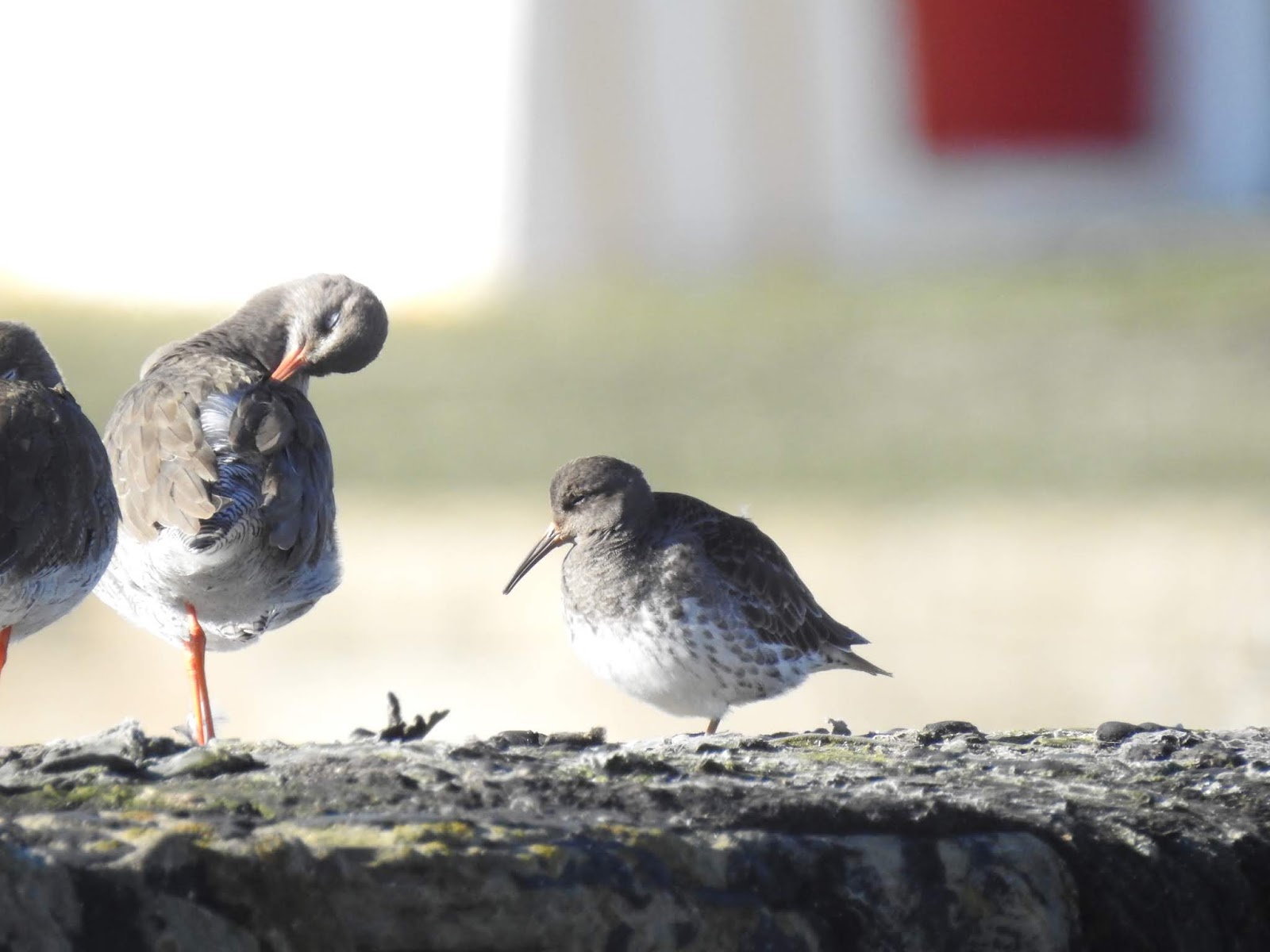
Purple Sandpiper


Curlew


Redshank


Long-Tailed Duck
Burghead Bay viewed from Roseisle on the Moray coast


March 2019 mammal sightings in more detail:


Mountain Hare
March is the last month to see our local Mountain Hares in their beautiful all-white winter coats, though a  few were definitely starting to morph into their spring blue/grey colours,  but they were undoubtedly 'mammal of the month', with many of my safari clients delighted to see them, often for the first time, and with their upland habitats being relatively snow-free for much of the month, they were not too difficult for me to find, and could actually be quite confiding, often allowing a reasonably close approach for photography....


Red Deer in their typical upland habitat


Red Deer seen in Abernethy Forest
Red Deer are most commonly seen in remote upland glens, and that was mainly the case again this month, however, when the weather turns really wintry, they sometimes desert the exposed uplands for the shelter of nearby forests, and that was the case in the middle part of this month...


Feral Mountain Goats
Still up in the glens, we at last got to see the Feral Mountain Goats with their very cute youngsters, and they proved to be very popular with my safari clients, many of whom were unaware that there are 'wild' populations of these very interesting animals in remote parts of the UK...


Roe Deer
Roe Deer were seen on most of my safaris this month, usually soon after dawn, but being one of the more 'nervous' animals,  they invariably 'disappear' upon noticing us, but I did manage a couple of snatched long-distance photos....


Red Squirrels are pretty reliable visitors to the quieter forest feeding stations, especially during the colder weather, and we managed to see at least one, and often more,  on every safari this month,  and we also had some nice random sightings in more natural settings too...


Joining our early Frogs, Toads and Bumblebees, this month also saw us getting our first sightings this year of Bats and day-flying Moths......


Late winter on a local heather moorland


Summary:


Looking back through my reports and pictures for this month, my safari clients certainly seemed to enjoy themselves, and I reckon we did pretty well despite the changeable and sometimes challenging weather. 
We saw plenty of lingering winter birds, a few newly-arrived summer birds, a good selection of indigenous local specialities and also had a few rarities  to entertain us, and after a week off, I now feel that I have 'fully charged batteries' ready for my favourite and busiest part of the wildlife calendar.... Spring... bring it on!


I know a lot of visitors to this area very wisely check out reviews of attractions at tripadvisor before 'taking the plunge' and booking - if you wish, you can check out my clients comments at the link below....thanks to all those that have made the effort to post me a review..... just cut and paste it into your web browser... 

https://www.tripadvisor.co.uk/Attraction_Review-g186537-d3335134-Reviews-Highland_Wildlife_Birdwatch_Safaris-Aviemore_Aviemore_and_the_Cairngorms_Scottish.html


If you think you know someone who may enjoy a taste of what I do, why not treat them to a safari gift certificate. They make a thoughtful and imaginative present, are available for any amount and are valid at any time within a year from date of purchase....


Thursday, February 28, 2019

February 2019 weather-wise, for the first week at least, continued where January left off, with northerly winds bringing plenty of snow and frosts and a typically wintry feel... then suddenly, and very unexpectedly, the winds switched direction, with southerlies bringing warm air up all the way from north Africa and giving us record high temperatures for February and three weeks of unseasonably spring-like conditions - great for us humans, but very confusing for the wildlife!
So with the days lengthening, snowdrops and crocuses blooming, woodpeckers drumming, songbirds singing, Bumblebees flying and temperatures in double figures for much of the month, it actually felt more like April than February!
Full-day local safari bird lists increased a little this month, with most of our winter visitors lingering and the first returning waders pushing numbers up into the high 40's, though a trip to the nearby Moray Coast or Black Isle can increase this number considerably, whilst mammal day lists varied between 4 and 8 species depending on the time of our start, duration of safari and number of habitats visited, with early starts usually proving more successful for the shyer creatures.

Late winter in a beautiful upland glen

To give you an idea of what you may realistically hope to see if you are planning a future February visit yourself,  I hope the following more detailed information, illustrated with photos taken in and around the Cairngorms National Park and nearby Moray coast, by myself , my friends or my safari clients will help - clicking on the picture will enlarge it to full screen.

Wildlife highlights:

Local speciality/upland bird species seen regularly during the month included: 

Black Grouse (at or soon after dawn only), Red Grouse, Crested Tit , Dipper , Goldeneye  and Goosander, we also had some decent sightings of Snow Bunting before the snowline receded..., and a few brief glimpses of Crossbills...

Winter visiting birds were represented by family groups of Whooper Swans and several species of 'grey' Geese, .. a few Waxwings, Bramblings and Redpolls were seen.and a couple of Great Grey Shrikes appeared locally from mid-month...


A good variety of seabirds, waders,  wildfowl and Geese were enjoyed at the Moray Coast and the nearby inland lochs...


Mammals seen regularly locally during the month included:

Roe Deer,  Red Deer, Reindeer, Red Squirrel, Rabbit, Mountain Hare (white), and Mountain Goat, with a couple of  sightings of Brown Hare and Sika Deer...

Common Seal and Grey Seal were both seen at the nearby Moray Coast...


February 2019 bird sightings in more detail:


Lekking Black Grouse
Dawn  (still a pretty user-friendly 7 am) on my safaris was usually spent at a local Black Grouse lek site, usually a raised grassy area, where we enjoyed the spectacle of up to 11 of these attractive, and sadly, increasingly rare, blue-black cock birds displaying, posturing aggressively and flutter-jumping in a bid to out-display and intimidate their opponents in a bid to secure their little patch of the moorland 'arena' for the forthcoming breeding season, all accompanied by their strange bubbling and whooshing calls drifting across the moor... surely one of British wildlife's 'must-see' (and 'must hear') experiences? 'Performances' were noticeably better on cold, still mornings.... but please be aware that sightings are not 'guaranteed' as the birds can fail to show in very mild or wet and windy weather....


Male Red Grouse
Still on the moors, our local  Red Grouse adopt a different approach to the breeding season, with the males choosing a 'territory', then defending it from rivals, and attempting to attract a mate,  with much calling and posturing and red eye wattles aglow, from the few higher vantage points, making them nice and easy for us to find!

Crested Tit by Bob Smith
In the Caledonian pine forests, our local Crested Tits continued to show well at my favourite forest feeding stations early in the month when conditions were wintry, especially soon after dawn, and particularly on the colder days, when they are presumably at their most desperate for food, with up to 3 of these true 'local specialities' showing at once...however... they became noticeably more elusive when things warmed up , and we actually had quite a few 'no-shows' as the month progressed ...though of course, if you know their distinctive calls and song, you do have a chance of seeing one whilst walking in the forest....
It is well worth noting that the colder winter months (October-Feb) are actually the best time of year for seeing the 'wee Cresties', as these characterful little birds can be frustratingly secretive, unobtrusive and almost silent during the breeding season, with sightings being much more difficult to obtain between March and September....

Male Crossbill
Continuing the forest theme, I was all set to 'cut and paste' my usual Crossbill sightings report saying "sadly, Crossbill sightings were, as usual, limited to very brief glimpses of birds flying over, with us only being able to identify them by their characteristic 'jip-jip' calls".. and that was indeed the case... up until the 27th, when a lovely male bird (at last!!) posed for me for a few seconds, and I actually managed a photo! Hallelujah!


Still in the forests, sadly, it is not such good news on the Capercaillie front... despite 13 pre-dawn walks, and many slow drives through (previously) good 'Caper' territory this year... I have still to see one myself this year.... let alone find one for my clients to see.....and I am not alone in struggling....worrying times for this iconic Highland species....

Dipper with nesting material
On the rivers, our Dippers are in full 'breeding season mode' now, and early morning visits to known favourite nesting sites (keeping a respectful distance of course) gave us great views of these characterful and hardy little birds singing their hearts out, with wings back and chests pushed out... and toward the end of the month we even saw one delivering nesting material....


Young Golden Eagle (they lose the white patches as they mature)

Common Buzzard (note the proportionately shorter wingspan and diagnostic white breast band)
Golden Eagle is a rare, iconic, localised and much sought-after bird in the UK, and as I have mentioned before, the shorter days of the winter months give us our best chance of seeing them.
This month continued the trend, and early in the month we were lucky enough to enjoy several memorable sightings of these majestic birds hunting in upland glens, though not as many as last month....
Raptors in general were again pretty well represented this month, with Kestrel, Sparrowhawk, Common Buzzard, Peregrine, Goshawk and Red Kite all being seen at least once...though I have still yet to see a White-Tailed Eagle this year.....


Snow Bunting
With the Cairngorm Funicular Railway still out of action for major repairs, and the snow-line receding way up towards the summit plateau making it likely that the Ptarmigan and Snow Buntings would do likewise...I didn't venture up into the mountain-tops myself this month, but we did manage some decent views of the Snow Buntings at lower levels during the first week...and a few intrepid birders who made the effort to walk up to the tops did manage a few Ptarmigan sightings....


Waxwing


Waxwing by Steve Nicklin

With very few berries left now, our remaining Waxwing flocks became very mobile in their search for food so sightings were a bit patchy, with them being seen in a hotel garden, a couple of car parks and a disused railway station among other places....but we still managed some great views, with many of my safari clients seeing these truly beautiful birds for the first time..


Brambling


Female 'redhead' Goosander


Whooper Swan


Great Grey Shrike - apologies for poor quality pic - taken at long range through a heat haze...

Other good birds seen or reported locally this month included: Whooper Swan, Goosander, Goldeneye,  Brambling, Redpoll, Bullfinch and Great Grey Shrike....


Sunrise over the Cairngorm Mountains as seen from a local upland moor


Moray coast highlights:


Red-Breasted Merganser by Steve Nicklin


Water Rail


Guillemot by Steve Nicklin


Purple Sandpiper by Steve Nicklin


Male Eider


Long-Tailed Ducks


Red-Throated Diver by Steve Nicklin

The Moray coast is only about a one hour drive north of Aviemore, and my trips to favourite reserves, lochs, bays and harbours gave good views of wintering birds such as Greylag Geese, Pink-Footed Geese, Whooper Swan, Water Rail,  Eider, Wigeon, Teal, Scaup, Pintail,  Bar-Tailed Godwit, Black-Tailed Godwit, Knot, Golden Plover, Ringed Plover, Purple Sandpiper, Common Scoter, Velvet Scoter, Red-Throated Diver, Guillemot, Goosander, Red-Breasted Merganser,and  Long-Tailed Ducks....


Lossiemouth Bay on the picturesque Moray coast


February 2019 mammal sightings in more detail:


Mountain Hare in it's typical habitat..


Stalking Mountain Hares...


Mountain Hare by Michelle and Phil Coyle
Our local Mountain Hares once again 'stole the show' this month, and it is very hard to argue against them regularly being voted as 'mammal of the day' when you take into account their gorgeous looks in their winter white coats, their relative scarcity in the UK, and the often spectacularly scenic upland habitat in which they are found. I was 'hired' for Mountain Hare photography safaris by several keen wildlife photographers this month, and I'm pleased to say that we achieved good results on most occasions, but it should be noted that it can often involve a lengthy walk on rough and often steep terrain....


Red Deer

Red Deer stag
Still up in the glens, Red Deer could often be seen well in their large same-sex herds, well, on the days when no shooting was taking place anyway!.... but only if you used a bit of fieldcraft, and concentrated on looking for them on the leeward side of the hills, as although they are pretty hardy, they are clearly sensible enough not to stay exposed to a strong wind....

Feral Mountain Goats
Also sharing the same upland habitat are Feral Mountain Goats, and we did much better this month, seeing them on nearly every occasion we visited the glens where they live, and although they were keen to keep their distance, there now appeared to be some youngsters among them...


Sika Deer by Jan Shields

Sika Deer were encountered on a few occasions on my safaris this month, with many of my clients seeing them for the first time. For those not familiar with this species, they originate from Asia and were introduced into the UK in the late 19th century...


Roe Deer by Steve Nicklin
Roe Deer however, can be a little trickier to see, being more wary of human disturbance, and most of our sightings were at dawn or in very remote areas, and were usually of the 'brief' variety, as they ran away on becoming aware of us...


What a poser! Red Squirrel by Jan Shields
In our local Caledonian forests, Red Squirrels put big smiles on my safari clients faces, with many of them seeing these rare cute and characterful little animals for the first time. Although most of our sightings are at feeding stations - they love peanuts! - we also had plenty of 'random' sightings of them whilst driving or walking along the quieter tracks...

Unusually for February, and undoubtedly due to the unseasonably mild weather, we also had our first sightings this year of Frogs, Toads and Bumblebees....at least a month earlier than normal!

Summary:

Well, after a quiet January, things really took off for my safaris this month, the great weather, half-term holidays and the continued 'Winterwatch effect' all combined well to keep me nice and busy, with loads of great wildlife seen, and my safari clients all seemed to have a great time., as did I!!

The Winterwatch teepee on the edge of Abernethy Forest


If you think you know someone who may enjoy a taste of what I do, why not treat them to a safari gift certificate. They make a thoughtful and imaginative present, are available for any amount and are valid at any time within a year from date of purchase....