October 2020 was definitely wetter than the average October in this area (a slight understatement!), though thankfully the winds were mainly quite light, meaning that wildlife watching conditions were actually pretty reasonable, if not always perfect. Temperatures in general remained mild for the time of year, but the few bright and sunny days saw us get our first frosts of this autumn, and the 23rd saw our first snowfall on the mountain tops.
Though the days are certainly shortening now, we still have around 10 hours (7am-5pm approx) of usable daylight, and the Highland scenery is still ablaze with glorious autumn colours, with most of the leaves still clinging on, and many of our berry trees still fully laden.
The autumn rains have restored the local rivers to their normal levels (and occasionally beyond!) allowing the Atlantic salmon to finally reach their spawning grounds in the upper reaches, though we have often struggled to see them in the flooded conditions
October is a really great month to witness visible bird migration in action, with large flocks of Geese, Swans, and Thrush species often witnessed flying noisily overhead, and this influx of winter visitors from colder areas further north, helped full-day safari bird lists increase up into the 40's, (or more if you include a trip to the Moray Coast), whilst mammal day-lists varied between 3 and 7 depending on the start time and number of venues visited, with early starts, as usual, proving to be best.
 |
An autumn dawn on a local upland heather moorland
|
To give you an idea of what you may realistically hope to see if you are planning a future October visit, I hope the following more detailed information, illustrated with photos taken at sites in and around the Cairngorms National Park by myself, my friends or my safari clients, will help....clicking on the picture enlarges it to full-screen.
Wildlife highlights included:
Local speciality bird species seen regularly during the month included:
Red Grouse, Crested Tit and Dipper, we also had several good sightings of Golden Eagle , a couple of White-Tailed Eagle, a few fleeting glimpses of Crossbills, two decent views of displaying Black Grouse, and even a decent, if sadly all too brief, glimpse of a splendid male Capercaillie...
Newly-arrived winter visiting birds were represented by Whooper Swans, several species of 'grey' Geese, and good numbers of Redwings and Fieldfares.
A good variety of waders and wildfowl were seen at the Moray Coast, and a few Bramblings were reported locally at the end of the month...
Mammal species seen regularly included: Red Squirrel, Red Deer (rutting), Reindeer, Roe Deer, Mountain Goat , Brown Hare and Rabbit......with just a couple of distant sightings of Mountain Hare , one glimpse of Stoat, and a single view of Sika Deer..
The last week of the month also saw us enjoy views of Atlantic Salmon starting to spawn in the upper reaches of our local rivers....
October 2020 bird sightings in more detail:
 |
Crested Tit - A true local speciality
|
Crested Tits, having been typically 'uncooperative' and elusive through the summer months, started to become more regular visitors to forest feeding stations, especially soon after dawn on the colder days, and we were fortunate enough to enjoy many excellent and often extremely close views of this true 'local speciality' on a number of occasions, as well as a couple of more random sightings of them in mixed winter flocks on our forest walks...
 |
Hand-feeding a Coal Tit
|
A bonus by-product of regular winter feeding is sometimes (especially on colder days) being able to feed the incredibly confiding Coal Tits and (sometimes) Great Tits by hand, an experience much enjoyed by my safari clients of all ages...Still in the forests, Crossbills, sadly, but rather typically, were somewhat less obliging however, with our views once again being restricted to snatched glimpses of birds flying overhead...identified only by their distinctive 'jip- jip' calls....a familiar tale...so sadly, there were no "through the scope" views or decent photo opportunities this month...
 |
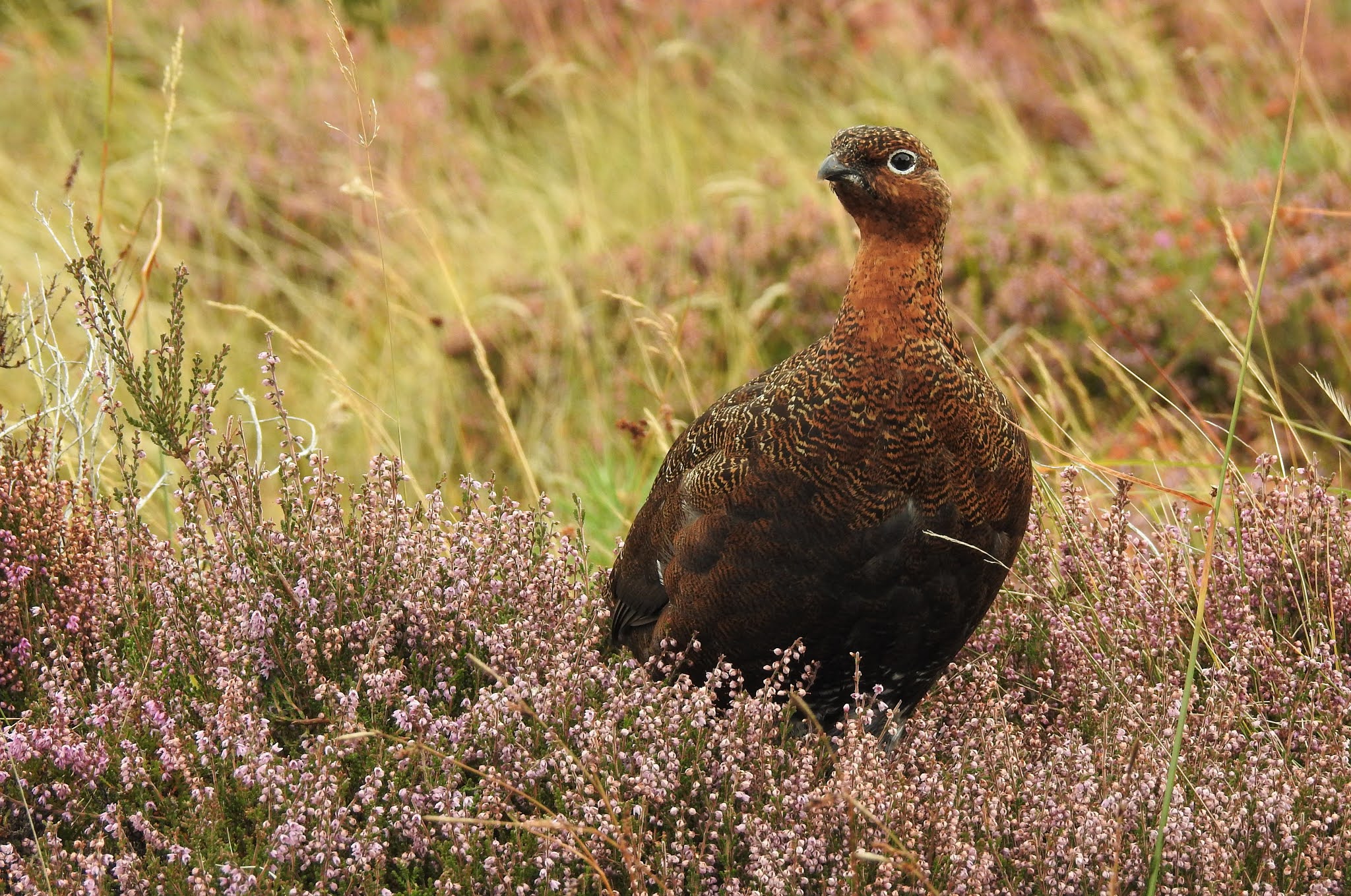
Male Red Grouse
|
 |
Female Red Grouse
|
Red Grouse, still largely in family groups were generally very obliging on our local heather moorlands, and by using my vehicle as a 'mobile hide', we often achieved excellent close-up views and photo opportunities.. and later in the month, a few of the more 'frisky' cock birds appeared to be getting a little aggressive and territorial in their behaviour....
 |
Displaying Black Grouse - an unusual sight in autumn..
|
Visits to Black Grouse leks were a little less predictable however, with results varying from none showing at all on most occasions, to 17 displaying males on one memorable morning...with seemingly no reliable pattern emerging yet..
 |
Male Capercaillie - A rare sight at any time!
|
Regular readers of this blog will know how difficult it has become to see Capercaillie nowadays...and that pattern continued....with the exception of a memorable encounter with a splendid and unusually 'showy' cock bird, seen posing on a fallen tree stump on the 10th...a moment to savour.
 |
A Dipper on a flooded local river
|
Dipper is a bird absent from large areas of central, southern and eastern Britain, preferring clear, fast-flowing upland rivers over murky, slow-flowing lowland waterways. Fortunately, if you position yourself on a bridge, they can be a fairly common sighting in this area, often seen swimming and diving to feed, or perching prominently on a rock, and always prove popular with my safari clients , though the floods late in the month did make seeing them much more difficult than normal....
 |
A soaring Golden Eagle
|
Golden Eagle is truly an iconic bird of the Scottish Highlands, and one that always seems to be on the 'wish-list' of my safari clients, and our regular visits to my favourite upland glens paid off on a good number of occasions this month, with some decent sightings of these hugely impressive creatures, sometimes hunting , often in aerial combat with other raptors or Ravens, or sometimes just soaring around....and towards the end of the month, presumably lured in by the spawning Salmon, we also saw White-Tailed Eagle...
 |
Peregrine Falcon
|
 |
A Common Buzzard drying it's wings
|
 |
Red Kite
|
If you are a bird of prey fan, it is worth noting that early winter is usually our best time of year for raptor sightings, and this month we also recorded views of Goshawk, Peregrine, Sparrowhawk, and numerous Kestrels, Red Kites and Common Buzzards...
 |
Fieldfares
|
 |
Redwing
|
 |
Whooper Swans
|
 |
A Barnacle Goose among the Pink-Footed Geese
|
Winter-visiting birds flooded into our area this month: Whooper Swans, Grey Geese (Greylag , Pink-Footed and a few Barnacle), and winter thrushes, first the Redwings, then the Fieldfares....and a few Bramblings... though I am still yet to see one....
Other good/scarce birds seen/reported locally this month included:
 |
| A winter-plumage Slavonian Grebe seen on a local loch |
 |
An unusual sight inland.. a (male) Long-Tailed Duck
|
Brambling, Yellow-Browed Warbler, Pochard, Scaup, Kingfisher, Long-Tailed Duck, Slavonian Grebe, Grey Partridge, Chiffchaff, Merlin, Hen Harrier, and a few lingering Swallows...
A few photos of more common birds seen locally this month:
 |
Great Spotted Woodpecker
|
 |
Mute Swans
|
 |
Male Stonechat
|
 |
Robin
|
 |
Coal Tit
|
 |
Male Bullfinch
|
Adventures 'out of area':
 |
Autumn at the picturesque Moray coast
|
 |
Little Auk by Liz Miller
|
 |
Common Guillemot by Steve Nicklin
|
 |
Razorbill by Steve Nicklin
|
 |
Redshanks by Steve Nicklin
|
 |
Turnstone by Steve Nicklin
|
 |
Red-Throated Diver by Steve Nicklin
|
The Moray coast is only about an hour drive north of Aviemore, and my trips to favourite reserves, lochs, bays and harbours gave good views of wintering birds such as Greylag Geese, Pink-Footed Geese, Brent Geese, Barnacle Geese, Whooper Swan, Shoveler, Wigeon, Teal, Scaup, Pintail, Bar-Tailed Godwit, Knot, Golden Plover , Grey Plover , Ringed Plover, Purple Sandpiper, Redshank, Oystercatcher, Turnstone, Curlew, Common Scoter, Velvet Scoter, Red-Throated Diver, Long-Tailed Ducks, and a Little Stint...
 |
Lovely autumn colours in a local upland glen
|
October 2020 mammal sightings in more detail:
 |
An impressive Red Deer stag stands guard over his 'harem' of hinds...
|
 |
Red Deer stag
|
'Mammal of the month' for October just has to be the Red Deer, with their spectacular annual 'rut' providing my safari clients with some superb entertainment - the fully antlered stags 'bolving' roars echoing through the glens, as they spend much of the month posturing , fighting off rivals and attempting to mate with as many of their 'harem' of hinds as possible - surely one of British nature's 'must-see' experiences?
Our local Mountain Hares - Britain's only native lagomorph - though still mainly in their browny-grey summer coats are gradually turning whiter from their feet upwards as autumn progresses, in preparation for the snow to come, though actual sightings of them were not as frequent, or as good as I would have liked... but that is not unusual during the 'milder' months..things should hopefully improve next month....
 |
Feral Mountain Goats
|
Still up in the glens, Feral Mountain Goats are mainly restricted to a few remote upland areas of the UK, and we are fortunate to have them locally in a few quiet glens, so many of my safari clients get to see them for the first time while out with me, and they proved to be fairly reliable this month...
 |
Red Squirrel
|
 |
Red Squirrel
|
In the forests, our Red Squirrels never failed to charm and entertain, with their cute looks, acrobatic leaping from tree to tree , reliable use of peanut feeders, gathering of drey materials and chasing off of rivals, and of course, with them being largely absent from most of the UK now, many of my safari clients were seeing them for the first time....
 |
Young Roe Deer
|
Roe Deer, although relatively common in most of the UK, can actually be quite tricky to see due to their naturally 'nervous' nature, and the fact that they can be very 'crepuscular' - being more active at dawn and dusk...but we managed plenty of good daytime sightings and even a few photo opportunities, on farmland and woodland edges this month..
Brown Hares, similarly to the Roe Deer, can be very nervous and 'crepuscular' in nature, and most of our best sightings happen in the first hour of daylight, and that proved to be the case again this month, though the light was too poor for decent photos...
 |
Murdo the friendly Highland Coo
|
Highland Coo's always prove to be popular with my safari clients, especially those who do not have them close to home, so don't be afraid to ask me if you fancy going to see them, and maybe even get to feed and 'pat' them, as I have a couple of great sites....
 |
Spawning Atlantic Salmon (photo from October 2016)
|
Mid October-early December is usually the time of year to see our Atlantic Salmon spawning. These remarkable and often very large fish spawn in the shallow waters in the upper reaches of our rivers, at the very spot where they themselves were hatched several years before, having originally spent 2-3 years in the river, then another 2-3 years feeding, growing and maturing out in the mid Atlantic, before undertaking a perilous journey many miles upriver, often involving avoiding poachers, anglers and predators and negotiating high falls and rapids on the way , an amazing migration story! However, sightings are very reliant on the rivers water levels - too little water and the Salmon cannot access the upper reaches - too much water, and they can get there... but we can't see them....fortunately, from the 27th onwards it all fell into place and we enjoyed some decent views, though it was often tricky in the flooded rivers...
Rare/nocturnal mammals:
I get a few enquiries about the possibility of seeing Badgers and Pine Marten from my safari clients, many of whom I suspect are unaware that they are actually a largely nocturnal creature, and although we do get the occasional (maybe one or two a year) dawn glimpse of one, you would definitely have a much higher chance of seeing them at a specific dusk Badger/Pine Marten watching hide - Please contact me for more information.
Similarly, our inland Otters too are mainly active during the hours of darkness, and again, although we do get a few early-morning sightings on local lochs and rivers each year, looking for them feeding in a suitably quiet, kelp - filled bay on the coast on a rising tide, but at any time of day, would give you a much better chance.
Whilst we are still on the 'tricky to see stuff', the Scottish Wildcat too, as well as being incredibly rare now, is also generally nocturnal, and the fact that I have had a mere handful of (dawn or dusk) sightings in 16 years of providing wildlife safaris should give you an idea of how difficult they are to see.
 |
Atmospheric early morning light in a local Caledonian forest
|
News:
I am very pleased to report that I have been pretty busy this month - A big thank you to everyone who has been out on safari with me since we were able to re-commence - Not only have you helped me to get started on the long road back to financial recovery, it has also been a treat to see so many of you enjoying the special scenic and wildlife wonders of this area, and your beaming smiles when hand-feeding the Coal Tits and Murdo the friendly Highland Coo have been a real tonic in these difficult and stressful times...
COVID-19
The Scottish Highlands has had very few COVID-19 cases in comparison to most of the UK, and on my safaris we tend to visit remote , wild habitats well away from the more popular tourist areas, and usually have very little interaction with other people, and this is something that I intend to continue.
I can advise that I have not had COVID-19, have no symptoms, and have not knowingly been in contact with anyone who has.
I re-commenced providing my wildlife safaris from 15th July 2020, subject to the following conditions/changes:
1) Parties will be limited to pre-booked small, preferably connected groups - so no mixing of unconnected parties unless we can do it safely and legally.
2) There will additional COVID-19 related health questions asked at the time of booking.
3) My safari vehicle will be deep cleaned before and after each safari.
4) We will use the middle and rear rows of seats in my vehicle (a spacious Land Rover Discovery 7-seater) in preference to the front passenger seat where possible.
5) Any parties uncomfortable with travelling in my vehicle will have the option to follow me in their own vehicles.
6) Whilst on board my safari vehicle your guide and all clients will be required to wear face coverings.
7) We will adhere to Government social distancing recommendations where possible.
8) All surfaces/equipment touched frequently will be cleaned regularly by your guide.
9) Hand sanitizer will be provided for guide and client use.
10) Clients will be asked to bring their own optical equipment where possible - any loaned/communal equipment will be cleaned regularly.
11) Clients will be asked to provide their own food/drink as we cannot do so at present.
12) Public toilets will be used where possible, with the option to return to client accommodation for comfort stops if required, and 'bush-toilets' only being used as a last resort.
13) If first aid is required, I may need to ask other members of the party to assist.
14) I will require all clients to complete a COVID-19 disclaimer/ infection declaration form.
15) A Health and Safety Executive risk assessment form has been completed and will be displayed in my vehicle..
If you have any questions/queries, please feel free to contact me.
 |
Peat-stained water flooding out of a local loch
|
Summary:
Well, despite the often 'uncooperative' weather, but aided by the beautiful autumn colours, the influx of birds from further north and the Red Deer rut, I reckon October 2020 was a very good month for wildlife-watching in this area, with a good selection of local specialitiy birds and animals (and fish!) seen, Coal Tits and a Highland Coo hand-fed, lots of fun had, and lots of 'enforced staycationer' safari clients from all over the UK going home with happy memories of their holiday in the Cairngorms National park, many of whom were visiting for the first, and I suspect (and hope), not the last time...
 |
Autumn at a popular local beauty spot
|
Reviews:
I know a lot of visitors to this area very wisely check out reviews of attractions/experiences at Tripadvisor before 'taking the plunge' and booking - if you wish, you can check out my clients comments at the link below....
https://www.tripadvisor.co.uk/Attraction_Review-g186537-d3335134-Reviews-
Highland_Wildlife_Birdwatch_Safaris-Aviemore_Aviemore_and_the_Cairngorms_Scottish.html
 |
Autumn cobwebs
|
Gift Certificates:
 |
Safari gift voucher
|
If you think you know someone who may enjoy a taste of what I do, why not treat them to a safari gift
certificate? They make a thoughtful and imaginative present, are available for any amount and are valid at any time within a year from the date of purchase....