Highland Wildlife and Birdwatch Safaris, Guided wildlife excursions, Aviemore, Scotland
Highland Wildlife and Birdwatch Safaris, Guided wildlife excursions, Aviemore, Scotland Highland Wildlife and Birdwatch Safaris, Guided wildlife excursions, Aviemore, Scotland

Friday, January 31, 2014

January 2014 was unseasonably mild (for these parts!), with no real extremes of weather , apart from  the odd very windy day. This, thankfully,  made it a much better month than December for wildlife watching, and I am pleased to say that my safari clients and I took full advantage, getting out in the wilds as much as possible, to enjoy some memorable sightings. The days are getting noticeably longer now, with around 9 hours of daylight, and although it is tempting to suggest that Spring is not too far away, I feel I should stress that it is really still midwinter this far north. Bird species day lists remained in the 30's, whilst mammal day lists varied between 5 & 8 species depending on our luck.

Wildlife highlights included:

Local speciality birds seen regularly this month included: Dipper, Red Grouse, Black Grouse, Crested Tit and Snow Bunting, whilst we also had a few brief views of Crossbill and Golden Eagle, and on the 30th, our first sighting this year of our local 'rogue' Capercaillie, who put on quite a show!
We were also fortunate to have a few true 'rarities' in our area, in the form of an Iceland Gull, a King Eider, and rarest of all, an American Coot!

Mammals seen regularly this month included Red Squirrel, Red Deer,   Roe Deer, Reindeer, Brown Hare, Mountain Hare (white), Rabbit and Mountain Goat, with a few brief glimpses of Bank Vole and Stoat (white), but the highlight has to be an unforgettable pre-dawn encounter on the 25th, on the edge of a local forest, with........ a Scottish Wildcat!! Only my 6th glimpse of this incredibly rare and declining creature in over 11 years living here!! Thankfully, both of my safari clients were awake and alert enough to see it too!

Bird highlight of the month, was the return of an old 'friend' - our local rogue Capercaillie, who, on my 7th attempt of the month to find him, suddenly emerged from his forest home, and then proceeded to display magnificently, and actually advanced towards us to make us retreat from 'his patch' - which we respectfully did! An unforgettable experience! (see pic)

Our local Black Grouse showed well at known 'lek' sites at dawn, with up to 4 cock birds seen displaying and posturing aggressively, with their loud bubbling and hissing calls clearly audible across the moor - always a great start to a safari day! (see pic)

The Red Grouse too, are clearly getting very territorial on our heather moorlands, with the cock birds seen laying claim to 'their' patch with much loud calling and chasing of rivals, their pre-occupation with each other often giving us the chance to get quite close, using the vehicle as a mobile hide, for good photo opportunities (see pic)

Crested Tit is a 'must-see' species for most of my safari clients, with them being very rare, sedentary and localised birds, and pretty difficult to see.. So I am always pleased, (and so are my clients!), when my winter tactic of feeding them regularly at several local Caledonian Pine forest sites pays off, with some excellent close-up views! (see pic)

Snow Bunting is a bird more usually associated with coastal saltmarsh during the winter, but we are fortunate to have a resident flock who frequent our local mountain, and who, like the Crested Tits, I have been feeding regularly at a few sites, and although they can be a bit 'flighty', especially when there are large numbers of snowsports enthusiasts around, occasionally we are able to get some good close-up photo opportunities (see pic)

Dippers continued to show well on our local rivers, and were seen to be 'dipping' and heard singing in the early mornings, and is another bird, which, although relatively common here, is absent from much of the UK, and is always popular with my safari clients from 'Dipper-free zones'

Crossbills were generally heard more than seen (as usual), though I did manage a decent view of one singing male bird atop a conifer, sadly on one of the days when I was birding 'solo'!

Golden Eagle sightings were noticeably less frequent than before Christmas, presumably because they are early nesters, and they now also have more hours of daylight in which to hunt, but we still managed a couple of half decent, if brief views.

Whooper Swans could be found on our local lochs and rivers, though the fluctuating water levels meant that they used many different sites to feed, which could sometimes make it difficult to locate them.

Grey Geese were seen regularly, mainly Greylag, but with a few Pink-Footed, and even the odd much rarer Snow Goose being reported from a few sites in nearby Aberdeenshire.


Wigeon and Teal are our most common winter wildfowl in this area, with a few Scaup and the odd Smew noted, but the star of the show is the Goldeneye, with the male birds now performing their elaborate courtship display, which involves them throwing their head back in a most comical fashion!

Last month I reported that I had a Lesser Redpoll coming to my nyjer seed feeder, well, he now has a friend! I now have 2 of these delightful little birds visiting regularly (see pic)

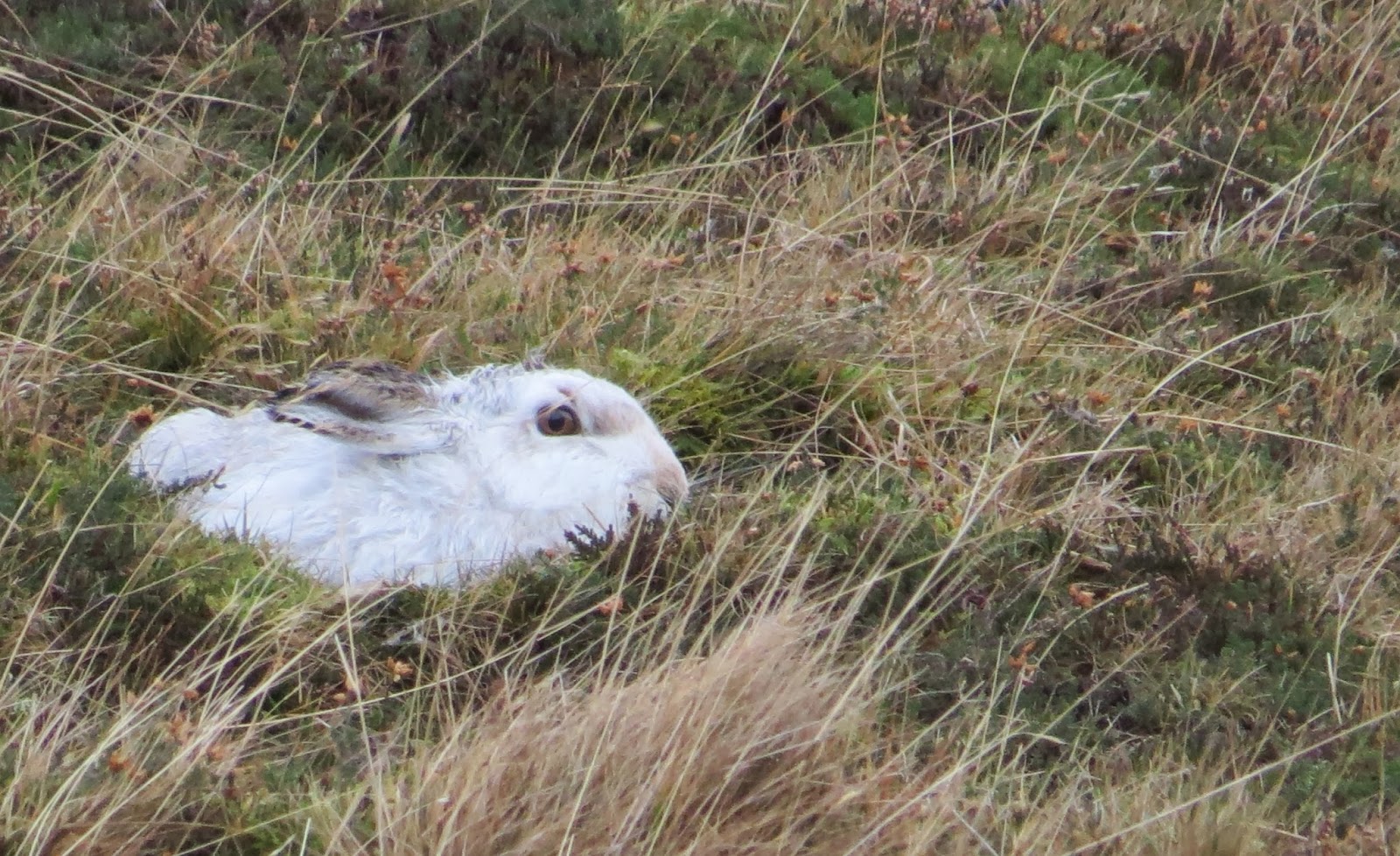
'Mammal of the month' was shaping up to be the white Mountain Hare, with all of my safari clients enjoying good views of these beautiful and very hardy creatures (see pic below), until the surprise sighting of the Scottish Wildcat, who rather cruelly, snatched the crown late in the month! Other local specialities such as Red SquirrelReindeer, Red Deer (see pic above) and Mountain Goat also proved popular.

So, I don't think it is unreasonable or boastful to say that we have got 2014 off to a very enjoyable 'flying start'! Lets hope it is a sign of things to come.....
Thanks for reading this - why don't you come and join us yourself in search of some memorable wildlife sightings in the varied habitats and beautiful scenery of the stunning Cairngorms National Park?


Friday, January 03, 2014

Merry Christmas and a happy and wildlife-filled new year to all my readers!
And a big "thank
you" to everyone who used my safari guiding services during the year....


December 2013 will not go down on record as a particularly good safari month weather -wise!
With snow, rain, floods and gales dominating, and with just a handful of decent wildlife-watching days, good sightings were at a premium, so I have therefore decided to file a 'typical' December report, using sightings and photographs from previous, more 'normal' Decembers....
The days are very short at this time of year, with only around 7 hours of daylight, but you can still reasonably hope to see 30+ bird species and 6+ mammal species given decent weather.

Typical wildlife sightings usually include:


Black Grouse at or near their moorland 'lek' sites at dawn, with the birds occasionally actually displaying on bright frosty mornings (see pic above)


Red Grouse too are usually fairly easy to see on our local heather moorlands in December, with the cock birds seemingly becoming territorial and often heard calling and seen displaying from raised areas (see pic above)

Dippers too seem to become very territorial at this time of year, with the cock birds even heard singing their high-pitched rippling warble ( a rare occurrence) at dawn whilst displaying...


Crested Tits are regular visitors to my favourite forest feeding stations during the winter months, with the lure of an easy feed seemingly hard to resist, though it should be noted that they are often very 'flitty', only staying for a few seconds, and are heavily outnumbered by the more common species..(see pic above)

Golden Eagles, and in fact, birds of prey in general, are usually seen more frequently in the winter months, with Kestrel, Buzzard, Red Kite, Peregrine and Sparrowhawk all appearing regularly, the shorter hours of daylight giving the birds less available hunting time...

Ptarmigan, looking resplendent in their winter-white plumage are a realistic target given some calm, sunny weather, though you will need to venture up to the snow-line in the mountains to have a chance of seeing them...

 
Snow Buntings too are best looked for in the winter months, and are a little more 'user-friendly', in that they can often be found at lower levels than the Ptarmigan , and can be very confiding, sometimes even visiting our ski centre car parks in search of food...(see pic above)


Whooper Swans (see pic above) are seen regularly on our local lochs and rivers, the Highland winter being more clement than their Arctic breeding grounds, where temperatures of -40c are not unusual!

Cold weather also drives other scarcer species such as Brambling, Yellowhammer, Bullfinch and Redpolls to visit feeding stations, and it is not uncommon for me to record all these species visiting my Aviemore garden in midwinter.


Mammals seen in an average December usually include Roe Deer, Red Deer, Reindeer, Red Squirrel, Brown Hare, Rabbit, Mountain Goat, and two more 'winter-white' specials, in Mountain Hare (see pic above) and Stoat, with the occasional dawn sighting of Otter.

The odd Salmon can still be seen in our local rivers, trying to make their way back out to sea, many looking a bit battle-scarred after the rigours of migration and spawning.


Looking back at 2013, I honestly think it was probably my most enjoyable and best year yet for wildlife sightings, and with the arrival of a 'proper' 7-seat 4x4 safari vehicle, and gaining a 5 star wildlife experience grading from Visit Scotland, it will be a hard act to follow, but I am sure it will be fun trying!

Friday, November 29, 2013

November 2013 marked the true arrival of winter in the Cairngorms National Park, with snow on the hills from early in the month, and a bit of just about every other type of weather, such as gales, sleet, hail, rain, sun and frost all experienced at some stage. Fortunately though, no real extremes of weather were forthcoming, so it was actually a decent month for wildlife watching, though the days are shortening noticeably now, with only 8-9 hours of usable daylight. Winter visiting birds continued to arrive from colder climes, and these extra species helped keep our bird species day-lists up around the 30 - 40 mark, whilst our mammal day-lists were steady at between 5 & 8 species depending on our luck.

Wildlife highlights included:

Local/upland speciality bird species seen regularly included Dipper, Crested Tit, Red Grouse, Golden Eagle (see pic below) and White-Tailed Eagle, whilst we also managed less frequent or fleeting glimpses of Crossbill, Black Grouse, Capercaillie and Ptarmigan.

Mammal species seen this month included Red Deer, Roe DeerReindeer, Rabbit, Brown Hare, Mountain Hare, Mountain Goat, Stoat and Bank Vole.

November is, in my opinion, THE month for seeing raptors in this area. With the combination of shorter daylight hours giving less available feeding time, the weather being  still reasonably clement, no deep snow and plenty of food around, ranging from small rodents up to large mammals such as Goats and Deer (yes, they are on the Eagles menu!) and including staples such as Rabbit and Hares, and even Salmon,  we have our best chances of seeing sought - after large birds of prey such as Golden Eagle and White-Tailed Eagle (see pic), if you know where and when to look.........
So, if it is Eagles you are after - book yourself a trip up here in November!

Still on raptors, as well as the two Eagle species, we also regularly encountered Red Kites (see pic),  Buzzards, Peregrine, Kestrel and Sparrowhawk, with just a couple of fleeting glimpses of Merlin and Hen Harrier.

Crested Tit is always high on my safari clients 'wish-list', being a very localised and rare UK bird, so I was delighted when they proved to be regular visitors to my forest feeding stations, giving some excellent close-up views and photo opportunities (see pic)

Red Grouse too, is a very localised species, only being reliably found on upland moors, which is a fairly rare habitat around much of the UK, but we are fortunate to have some excellent and reliable sites in this area, which regularly produced good sightings (see pic)

Dipper too, is a bird absent from large areas of Britain, preferring clear, fast-flowing upland rivers over murky, slow-flowing lowland waterways. Fortunately, it is a fairly common sighting in this area, often perching prominently on a rock, and always proves popular with my safari clients (see pic)

Ptarmigan is not a species that features regularly on my safaris, but a regular client was very keen to try and see one, and fortunately, her visit coincided with a short window of opportunity where we had weather conditions conducive to taking a walk up high in the mountains, and thankfully, after a fair amount of physical effort and patience, we obtained some pretty decent views (see pic)

Black Grouse  were seen at dawn on a couple of occasions on traditional 'lek' sites on cold, frosty and still mornings, but were absent on several occasions when I visited in milder, wet or windy conditions.

Capercaillie proved very elusive this month, with just one brief glimpse of two female birds at dawn , seen taking grit from a quiet forest track.

Crossbills too proved difficult, with our forest habitat sightings being limited to a number of fly-over flocks only being identified by their distinctive 'glip glip' calls.

Redwings and Fieldfares were seen fairly regularly, but became more elusive as the month progressed, as the birds presumably made their way further south, having consumed most of the berries in this area!

Grey Geese flocks in this area seemed to be all of the Greylag species, though we may well get some other species as winter progresses..

Whooper Swans were seen regularly on local lochs, often announcing their arrival with their distinctive, loud bugling calls.

Winter wildfowl numbers increased, with Wigeon and Teal being the species most commonly seen, though sightings of a Long-Tailed Duck and a Scaup were also reported on local lochs.

Woodcock is a bird usually only seen at dusk 'roding' over woodland, but during the winter months we occasionally get a few sightings of these beautiful, but cryptically plumaged birds feeding in the leaf litter at the side of quiet forest edges.

Mountain Hare is probably the most sought after mammal in this area, and it is quite understandable , as they begin to get their beautiful white winter coats about now (see pic), and are a very localised and rare species, being found only in upland areas.

Fish do not appear very often on my reports, but November is probably the best month of the year to see our  Atlantic Salmon (see pic). These remarkable and often very large fish spawn in the shallow waters in the upper reaches of our rivers, at the very spot where they themselves were hatched several years before, having originally spent 2-3 years in the river, then another 2-3 years feeding and maturing out in the mid Atlantic, before undertaking a perilous journey many miles upriver, often involving negotiating high falls and rapids on the way - an amazing migration story!

So, although many people seem to get the 'winter -blues' as the days shorten and the temperatures drop , as a wildlife watcher, it is far from the case for me up here, with November now one of my favourite and most productive safari months, with lots of great wildlife to be enjoyed, and often in spectacular snowy scenery.....


Monday, November 04, 2013

October 2013 was a generally windy month in this area, with temperatures starting at the mild end of the scale, but dropping throughout the month, and ending up with a wintry feel to things, with the first frosts and proper snow on the mountain tops. Inward migration from further north was in full swing , with the incoming Geese, Thrushes, Swans and wildfowl pushing our bird species day-lists up into the high 30's and low 40's, whilst our mammal day-lists varied between 5-9 species depending on our luck. The beautiful autumn colours are at their best now, but the days are getting noticeably shorter, with only around 11 hours of daylight, and autumn is definitely turning into winter.

Wildlife highlights included:

Local speciality bird species seen this month included Crested Tit, Crossbill, Black Grouse, Red Grouse, Dipper, Golden Eagle, 'Grey' Geese, Whooper Swan...

Mammals seen this month included Red Deer, Roe Deer, Reindeer, Red Squirrel, Mountain Goat, Brown Hare, Mountain Hare, RabbitBank Vole, Stoat,  Atlantic Salmon...

Red Deer stags 'rutting'. October is THE month for witnessing this annual 'must see' event on the British wildlife calendar, with the magnificent fully-antlered stags rounding up their 'harems' of hinds, protecting them from other rival stags with much roaring, aggressive posturing and occasional actual combat, whilst attempting to mate with as many of them as possible...(see pic)

Winter Thrushes poured in from the north throughout the month, first, the 'seep seep' calls overhead alerted us to the Redwings arriving, shortly followed by the 'chack chack' of the Fieldfares. Both species then proceeded to pillage our local berry bushes, much to the annoyance of our resident Blackbirds and Thrushes! (see pic)

Grey Geese flooded into our area too, mainly Greylags (see pic) but Pink-footed were noted too, with large flocks feeding hard in local stubble fields.

Whooper Swans began to appear on our local lochs from early in the month, their amazing 'trumpeting' calls announcing their presence, as they circled before landing. They will stay now until spring, taking advantage of our 'relatively' mild winter conditions.

Crested Tits were seen regularly at and around feeding stations in our local Caledonian pine forests, though they are greatly outnumbered by the more common tit species and are usually frustratingly flitty, rarely remaining still for long, making photography very difficult, though I was fortunate to manage a few half decent shots (see pic)

Golden Eagle is a species which actually becomes more likely to be seen as the days shorten, and their available hunting time decreases, and , true to form, we were lucky enough to have several decent sightings of these magnificent birds hunting along the ridges of a local upland glen - magic!

Red Grouse showed well on a number of occasions on our local moorlands, mainly still in family groups, though a few cock birds appeared to be getting a little territorial, calling and displaying from higher parts of the moor.

Black Grouse were seen at dawn on a few occasions, though only on cold, still mornings, which were very few and far between...

Crossbills were again a bit frustrating, with us getting fly-over flocks on many occasions, their 'glip glip' calls identifying them, though good sightings were again very seldom achieved..

Dippers were seen frequently, and are always a popular bird with most of my safari clients, probably because they are absent from much of the country's urban  and lowland waterways, favouring the faster flowing clear waters of upland rivers..

Salmon began to make there way up our local rivers towards their spawning grounds, though the lack of water hampered their progress, until some heavy rains at the end of the month raised the levels enough to allow them access to the upper reaches (see pic)


When birders talk of 'winter flocks', most would think of groups of Tits, Goldcrests and Treecreepers in woodlands, but we also see huge mixed flocks of Finches and Bramblings on our local farmland, and Siskins and Redpolls in our riverside trees...

So, to summarise, Thanks mainly to the miracle of migration, October is an excellent month for bird watching in this area, and add in the Red Deer rut, the magnificent autumn colours and some half decent weather, I can wholeheartedly recommend a visit......


Friday, October 04, 2013

September 2013 was generally dry and mild in this area , with strong winds mid-month, but no real extremes of weather. I was away on holiday visiting relatives for the second half of the month, so my report will be shorter than usual, and will contain some 'general' observations from previous September experiences.
With all of the summer visiting bird species gone by mid-month, and with the winter visiting bird species yet to arrive, bird day-lists are probably at their smallest, with around 30-40 species being seen, though mammal day-lists are still strong at 5-9 species.
Scenically, the Cairngorms National Park is as pretty as a picture, with the heather a vivid purple, many trees full of brightly coloured berries and a few with leaves turning their autumnal golds and coppers.

Wildlife highlights included:

Local speciality bird species seen during this month included: Osprey (early month only), Crested Tit, Crossbill, Red Grouse, Black Grouse, Dipper, Golden Eagle...

A few of our local juvenile Ospreys lingered in the area (see pic), giving us our last chances for this year to witness them plunge-diving for fish, though by mid-month the nests were empty, and will now remain so until late March........

Red Grouse continued to be seen in good numbers on our local heather moorlands, though as it  is still shooting season, they were still a little edgy and less confiding on the managed estates...(see pic)

The winter flocks continued to grow in our local forests, with some containing 50+ birds of 7 or more species , with a fair level of fieldcraft and patience being required to pick out the few Crested Tits amongst them.. though a few obliging Cresties continued to visit forest feeding stations, making life a little easier! (see pic)

Crossbills were also seen on several occasions in suitable coniferous forests, though most sightings were of the rather frustrating 'fly-over' variety, with identification being made by their 'glip glip' calls..

Black Grouse could occasionally be seen at dawn at or near traditional 'lek' sites, though they were not totally reliable, with colder mornings proving more successful...

Golden Eagle was noted on a few occasions in secluded upland glens, and this species, along with the other raptors, is a group of birds that actually become more likely to be seen as winter approaches. As the days grow shorter, they have less available hunting time, so our chance of seeing them increases...

Dippers are seen regularly on our local rivers, and autumn sees them starting to become territorial, with much aggressive posturing and chasing around going on....(see pic)

The end of September usually sees the start of the Red Deer rut, with the stags beginning to 'check-out' the hinds, sharpen up the tips of their antlers on rocks and trees, and partake in a little gentle 'sparring' with likely rivals, all accompanied by a tremendous 'roaring', which echoes round the glens... a marvellously atmospheric spectacle....

Still up in the glens, our Mountain Hares are turning noticeably whiter, from their feet upwards, as autumn progresses, in preparation for the snow to come....

A Kingfisher was an unusual sighting on a local loch, with the species being only rarely reported in this area, and generally on the rivers and at lower altitudes...

A Waxwing up near Inverness late in the month was a very early report of this 'irruptive' species, with the usual first sightings occurring in November...

So, although it is probably fair to say that September is a 'transitional' month, and can be a bit hit and miss where migratory birds are concerned, we still have plenty of endemic local speciality bird species to entertain us, and of course, our mammal species , being non-migratory, can usually be relied upon to provide some good sightings....whilst the beautiful Highland scenery gives us a last splash of colour before winter comes....


Sunday, September 01, 2013

August 2013 was much more changeable than the previous month in this area weather-wise, with the odd breezy or showery day, and with  temperatures noticeably cooler, and the days noticeably shortening, there was actually a slightly autumnal feel to things towards the end of the month.....
Mid-month saw many of our summer visiting species migrate away towards their wintering grounds, and as a consequence, our bird day-lists dropped a little more into the 40's or even low 30's, whilst our mammal day-lists varied between 5 and 9 depending on our luck. The heather is near it's vibrant purple best now, the Rowan trees are full of bright orange and red berries, and with plenty of wild flowers and butterflies still around, the Highlands are a beautiful place to be.....

From a purely personal point of view, the big highlight since my last report, was to get notification from Visit Scotland that Highland Wildlife & Birdwatch Safaris has been awarded a 5 Star Wildlife Experience grading following a visit from one of their quality assurance 'mystery shoppers'. Although the main objective of my safari/guiding service is to provide my clients with an enjoyable and memorable day of wildlife-watching in unique and  varied habitats and  beautiful surroundings, it is nice to get 'official' recognition that you are doing a good, professional job of it too.....(see pic)

Wildlife highlights included:

Local speciality bird species seen regularly throughout the month included Dipper, Crested Tit, Osprey and  Red Grouse, with Slavonian Grebe, Red-Throated Diver and Black-Throated Diver only noted reliably often up to mid-month. Merlin, Crossbills and  Golden Eagle were observed on a few occasions , but Black Grouse and Capercaillie were generally hard to come by...

Mammals seen this month included: Roe Deer, Reindeer, Red Deer, Red Squirrel, Rabbit, Brown Hare, Bank Vole, Mole,  Mountain Goat, Mountain Hare.

Osprey was again probably  the 'star' bird of the month, at least in the first half anyway, with my safari clients enjoying seeing them plunge-fish on several occasions, though one juvenile bird had a close call when it became water-logged, and struggled to slowly 'paddle' itself to the bank - phew!

Crested Tits continued to visit my favourite forest feeding stations reasonably regularly, usually early in the mornings, giving many of my safari clients their first ever sighting of this very rare and very localised little bird. (see pic)

Red Grouse continued to be seen regularly on our local moorlands, though for some reason, they became noticeably more 'twitchy' and less easy to find after the 'Glorious 12th'........(see pic)

Dipper is a bird that those of us who live in upland areas probably tend to take for granted, but it is important for me to remember that the vast majority of my clients actually live in lowland and  urban areas, and are therefore usually very pleased to get good views of these charismatic and hardy little river dwellers..

Capercaillie  is a very difficult bird to find in summer and autumn, but an early start one morning gave us decent, if brief views of 2 female birds taking grit from the side of a forest road.

Slavonian Grebe is a very rare and declining species in the UK, with just a few pairs to be found on suitable secluded Highland lochs, so it was good to see that one of our local pairs had bred successfully this year...(see pic by Bob Smith). Though they had largely left the area by the end of the month...

Red-Throated Diver, and Black-Throated Diver - still in their striking summer plumage -  were both seen with youngsters on local lochs early in the month, though  they were not noted after mid-month...

Crossbills were seen and heard (usually just in flight) on a few occasions in their favoured Caledonian Pine forest habitat, though good sightings were very hard to obtain..

Merlin, our smallest resident raptor, was seen briefly on a few occasions, usually flashing past  in hot pursuit of a Meadow Pipit!

Hobby was noted hawking dragonflies over local lochs on a few occasions, though one was seen to be hunting larger prey , in the form of Swallows!

Red Kites are definitely becoming  a more regular feature over our local hilly farmland areas and moors. They were reintroduced on the Black Isle north of Inverness over 20 years ago, but have, until recently,  failed to thrive due to their fondness for feeding on carrion, this making them susceptible to poisoning on some Grouse moors....(see pic)

Hen Harrier too, is a raptor which should be seen far more regularly over our moorlands than it is, again , probably due to illegal persecution, but one beautiful male bird put in a few brief appearances early in the month... (see pic by Bob Smith)

Although most of our breeding wader species left this area last month , we had a few sightings of Common Sandpiper and Greenshank, presumably birds on passage,  on our local lochs.

Although I didn't manage a trip up myself this month, our mountain top bird species - Ptarmigan and Snow Bunting were reported on a few occasions, though it would appear that the Dotterel had already left the area..

Mixed 'winter flocks' of various Tits , Finches, Treecreepers and Goldcrests, and even  the odd Crestie began to form in our forests towards the end of the month, a sure sign that the seasons are changing....

Purple poo! The annual bounty of Blaeberries in the Caledonian Pine Forests provides a very welcome (and tasty!) food source for our local wildlife, with colourful evidence on the tracks showing  that our local Roe Deer, Red Squirrels, Pine Martens and Capercaillies had all taken advantage of it...

The Moray Firth Dolphins continued to show well on a rising tide at Chanonry Point on the Black Isle and at Spey Bay, with the low river levels causing a tailback of Salmon to congregate at the river mouths waiting to migrate upriver, the Dolphins were not slow to take advantage of this relatively easy food source!

So, to summarise, although August is often to be considered to be  a bit of a 'quiet' wildlife watching month in many areas, it is definitely not the case this far north, with plenty of good stuff still to be seen......