Highland Wildlife and Birdwatch Safaris, Guided wildlife excursions, Aviemore, Scotland
Highland Wildlife and Birdwatch Safaris, Guided wildlife excursions, Aviemore, Scotland Highland Wildlife and Birdwatch Safaris, Guided wildlife excursions, Aviemore, Scotland

Monday, October 31, 2016

October 2016 was a very good month for wildlife-watching in this area weather-wise. With high pressure and, unusually, easterly winds dominating for most of the month, we enjoyed lots of calm and sunny, if occasionally a bit chilly weather, with very little rain throughout the month.
Though the days are certainly shortening now, we still had around 10 hours of usable daylight, and the Highland scenery is still ablaze with glorious autumn colours, with most leaves still clinging on, the berry-bearing trees fully laden, and the first dustings of snow on the Cairngorms providing many of my safari clients and myself with some very picturesque landscape photo opportunities.
October is a great month to witness visible migration in action, with large flocks of Geese, Swans and Thrush species often witnessed flying noisily overhead, and this influx of winter visitors from colder areas further north, helped full-day safari bird lists increase up into the 40's, whilst mammal day-lists varied between 4 and 9 depending on the start time and number of venues visited.

Autumn at Insh Marshes

Wildlife highlights included:

Local speciality/upland bird species seen regularly during the month included:
Black Grouse, Red Grouse, Crested Tit, Golden Eagle, White-Tailed Eagle, and Dipper, we also had a few glimpses of Crossbill, and a solitary sighting of Hen Harrier. Whilst a mountain-top adventure also gave us great views of Ptarmigan...and winter visiting birds were represented by Whooper Swans, several species of 'grey' Geese, Redwings and Fieldfares,  a few Waxwings were seen feasting on berries at the end of the month...and even a couple of Yellow-Browed Warblers and a Snow Goose were reported nearby.....

Mammals seen regularly during the month included:
Red Deer (rutting), Roe Deer, Reindeer, Red Squirrel, Rabbit, and Mountain Goat, with just a few sightings of Brown Hare and Mountain Hare, and just one brief glimpse of a Stoat. The last week of the month also saw us enjoy great views of Atlantic Salmon spawning in the upper reaches of local rivers....
And a day on Mull produced Otter, Porpoises and Dolphins.....

Black Grouse
The cock Black Grouse on our traditional moorland 'lek' sites, having largely been missing since early June, began to assemble and occasionally even display at dawn, especially on the colder mornings, with my safari clients and I seeing up to 6 birds at once, although the (still summer length) long grass made viewing quite tricky at times....
Red Grouse (female)
Our local Red Grouse appeared to still be in their (sadly now smaller) family groups, and with the shooting season virtually over, they seem a little less wary and can be a bit easier to see, especially when using my safari vehicle as a slow-moving mobile hide on the quiet tracks through their heather moorland home.
Crested Tit
Crested Tits, having been generally 'uncooperative' through the summer months, began to become more regular visitors to forest feeding stations, especially soon after dawn, and we were fortunate enough to enjoy some decent and often close views of this true 'local speciality' on a number of occasions....
A bonus by-product of regular winter feeding is sometimes (on colder days) being able to feed the incredibly confiding Coal Tits and (sometimes) Great Tits by hand, an experience much enjoyed by my safari clients...

Crossbills, sadly, but not unusually, were somewhat less obliging however, with our views being almost totally restricted to snatched glimpses of birds flying overhead...identified mainly by their distinctive 'jip- jip' calls....

Golden Eagle
Golden Eagle is truly an iconic bird of the Scottish Highlands, and our regular visits to my favourite upland glen paid off on numerous occasions, with a number of very decent sightings, and a couple of very memorable close-up views of these majestic (and huge!) raptors being obtained.

White-Tailed Eagle
The same glen also gave us a couple of sightings of the even larger White-Tailed Eagle , with one particularly obliging juvenile bird giving us a splendid close-range fly-past, after a brief aerial battle with a Hen Harrier! on the 20th of the month, and it being a fairly slow flyer, I even managed to grab a couple of photos...
The shorter days of the winter months actually seem to give us more chance of seeing Eagles, as they have less available hours of daylight hunting time....

The same seems to apply to the other birds of prey too, with Common Buzzard, Kestrel, Sparrowhawk, Peregrine, Red Kite, and even Goshawk and Hen Harrier all being seen on my safaris this month.

Dipper by safari client Andy Jackson
Dipper is a bird absent from large areas of Britain, preferring clear, fast-flowing upland rivers over murky, slow-flowing lowland waterways. Fortunately, it is a fairly common sighting in this area, often perching prominently on a rock, and always proves popular with my safari clients ...

Ptarmigan
A walk up towards the summit of Cairngorm mountain mid-month, braving sub-zero temperatures , low cloud, and winds gusting to 63mph gave us great, but hard-earned views of over 30 Ptarmigan, in various states of plumage, with a few almost completely white now...

Newly-arrived Greylag Geese and Whooper Swans
The Moray coast is only about an hours drive north west of Aviemore, and a couple of trips to favourite reserves, bays and harbours gave good views of incoming winter migrants such as Greylag Geese, Barnacle Geese, Pink-Footed Geese, Brent Geese,Whooper Swan, Wigeon, Teal, Pintail,  Bar-Tailed Godwit, Knot, Golden Plover and Grey Plover.... and scarcer birds such as Snow Goose, Scaup and Green Sandpiper..


Fieldfares
Winter thrushes flooded into our area from their summer breeding areas further north and east, first the Redwings, followed soon after by the Fieldfares, and they soon set about pillaging our local berry supplies, much to the annoyance of our resident Blackbirds and Thrushes!


Waxwing
Waxwings arrived in our area late in the month, with several small flocks of these beautiful  'viking invaders' adding another splash of colour to the already impressive autumnal backdrop as they pillaged the berries from our trees and bushes, their confiding nature often allowing decent photo opportunities ....


Onto mammals now....
Red Deer stag by safari client Andy Jackson
'Mammal of the month' for October has to be the Red Deer,  with their spectacular annual 'rut' providing my safari clients with some superb entertainment - the fully antlered stags 'bolving' roars echoing through the glens, as they spend much of the month  posturing , fighting off rivals and attempting to mate with as many of their 'harem' as possible - surely one of British nature's 'must-see' experiences?
Roe Deer
Although not as physically impressive as their Red cousins, Roe Deer are probably more often described as cute, but always seem to prove popular with my safari clients, and we were fortunate enough to see them on numerous occasions this month, usually on marshland and woodland fringes, especially soon after dawn....


Red Squirrel
But, when it comes to cuteness..... our local Red Squirrels take some beating, as they again put smiles on many of my safari clients faces, especially those seeing these attractive and characterful little creatures for the first time...


Mountain Hare
Up in the glens, we had reasonably regular sightings of Mountain Hares (slowly morphing into their white winter coats) and feral Mountain Goats, though sadly, most of the views were at quite a distance, so really good photos eluded me this month.....


Spawning Atlantic Salmon
Atlantic Salmon continued to make their way up our local rivers towards their spawning grounds, though the lack of water definitely hampered their progress, until some rain late in the  month raised the levels enough to allow them access to some of the upper reaches, where we were then fortunate enough to be able to see them 'leaping' up falls, and also actually watch them spawning in the shallows..


My trusty Land Rover Discovery ready for action...

So, to summarise, helped by the decent weather, the annual Red Deer rut, and the miracle of migration, October 2016 turned out to be yet another very enjoyable month for wildlife watching in the Cairngorms National Park, with plenty of excellent sightings, many memorable experiences, lots of happy safari clients, and the odd surprise, all set against beautiful autumnal Highland backdrops.......


Autumn at Loch Insh

Friday, September 30, 2016

September 2016 was a really good month weather-wise in this area, being drier and sunnier than most of the months preceding it, and the winds were generally light.
The days are shortening noticeably now though, with only around 12 hours of usable daylight , but by way of consolation, the heather is still a lovely purple, many trees are full of colourful berries, and the leaves and ferns are starting to change into their attractive autumnal hues.....
I was away in southern England visiting relatives and friends for a good part of the month, so my report will be a little shorter than usual, and will contain some general observations and pictures from previous Septembers.....
With just about all the summer visiting bird species gone by mid-month, and the winter visiting bird species not yet arrived, full-day bird lists dropped down to their lowest levels of the year (in the 30's), whilst mammal day lists varied between 4 and 8 species, depending on the time of our start and the number of different habitats visited, with early starts usually proving to be more fruitful...

Late summer in a beautiful upland glen
To give you an idea of what you may realistically hope to see if you are planning a future September visit, I hope the following more detailed information, illustrated with photos taken by myself or my safari clients will help........

Wildlife highlights included:

Local speciality bird species seen regularly during the month included: Osprey (first week only), Dipper, Red Grouse, Crested Tit and Goldeneye, and a couple of sightings of Golden Eagle....

Mammal species seen regularly included: Red Squirrel, Red Deer, Reindeer, Roe Deer, Mountain Goat and Rabbit......with just a couple of brief glimpses of Stoat and Bank Vole...

A few of our local Ospreys lingered around their now redundant nest sites and local lochs for a few days early in the month, giving us our last chance to admire these impressive raptors and their fishing skills, until they return in the spring.......

Red Grouse
The Red Grouse on the upland moors, many still in family groups, continued to entertain my safari clients, but with it still being shooting season though, they - unsurprisingly - seem a little wary of humans...but by using my vehicle as a mobile hide, we were often able to get some decent photographic opportunities...

Crested Tit
Crested Tit is always high on my safari clients 'wish-lists', and although they are now mainly to be found in mixed flocks roaming around the Caledonian pine forests, we also managed to get some decent views of them at my feeding stations, especially soon after first light ...

Dipper
The Dippers on our local rivers began to be seen a little more regularly, and even appeared to be getting a little territorial, with some singing being heard, and aggressive behaviour being witnessed near to prime nest sites, especially at first light...

Kestrel
Golden Eagles are more commonly seen on my safaris during the short days of winter, when they have less hours of daylight in which to hunt, but we actually had a pretty good 'strike-rate' this month, with a favourite upland glen providing decent sightings on a number of occasions.
Raptors in general seemed to be pretty active throughout the month with us seeing Peregrine, Red Kite, Common Buzzard, Sparrowhawk and Kestrel regularly as well...

Onto Mammals now....


Red Squirrel
As I mentioned last month, with the summer visiting local speciality birds departing this area, mammals become more of a focus on my safaris, and we were fortunate to see a good variety again this month. The  'mammal of the day' award was invariably won by the Red Squirrel - with many of my safari clients seeing these these very characterful and attractive 'Highland speciality' animals for the first time..

Red Deer
The end of September usually sees the start of the Red Deer rut, with the stags beginning to 'check-out' and assemble their 'harems' of hinds, sharpen up the tips of their antlers on rocks and trees, and partake in a little light 'sparring' with likely rivals, often accompanied by a tremendous 'roaring', which echoes round the glens... a marvelously atmospheric spectacle....

Still up in the glens, our Mountain Hares, though still in their browny-grey summer coats are gradually turning whiter, from their feet upwards as autumn progresses, in preparation for the snow to come, though actual sightings of them were not as frequent, or as good as I would have liked...

Feral Mountain Goats
The same could be said about the feral Mountain Goats, as they only featured a couple of times, and our views were restricted to fairly distant sightings through the telescope...

Although not as physically impressive as their Red cousins, Roe Deer are probably more often described as cute, but always prove popular with my safari clients, and we were fortunate enough to see them on several occasions this month, especially soon after dawn....


Highland Cattle
Although not really a 'wild' animal, Highland Cattle always seem to be popular with my safari clients, and I am often asked to stop for photographs....

So despite my absence for much of it, while I was here, September 2016 was actually a pretty decent month for wildlife watching in this area with some very memorable and enjoyable experiences, all in spectacular scenery, and now, with my 'batteries recharged',  the winter visiting birds due to arrive soon, and the Red Deer rut looming, I am already looking forward to October....

Thistles in their prime

Wednesday, August 31, 2016

August 2016 weather-wise, really was, to use an old football cliche, a month of two halves up here! The first half saw us endure gales (of up to 115mph at Cairngorm Mountain), then heavy rain, followed by an unusually cold spell, with a few overnight ground frosts! Thankfully, the second half saw high pressure dominate, and the accompanying warmer, more settled weather was much appreciated by myself, my safari clients, visiting tourists, and I suspect, the wildlife too!
The days are noticeably shortening now as autumn approaches, but we still have 14-15 hours of usable daylight this far north.
With many of our summer visiting bird species departing this area for their wintering areas throughout the month, it was inevitable that full-day bird day-lists would reduce down into the 30's, whilst mammal day lists varied between 4 and 8 species, with earlier starts generally proving more successful. By way of consolation though, August is usually our best month for Butterflies and day-flying moths, and this month followed the trend, with a good variety being seen, though sadly,  in lower numbers than in previous years.
The Highland scenery is extremely picturesque now, with the heather at it's beautiful purple best, one or two ferns turning coppery gold, a few leaves beginning to 'turn', and the Rowan trees fully laden with brightly coloured berries.

Late summer on a local heather moorland

To give you an idea of what you may realistically hope to see if you are planning a future August visit, I hope the following more detailed information, illustrated with photos taken by myself or my safari clients will help........

Wildlife highlights included:

Local speciality bird species seen regularly included:
Red Grouse, Crested Tit, Dipper, Goldeneye and Goosander, whilst Osprey, Slavonian Grebe, Red-Throated Diver, and Black-Throated Diver were all seen regularly early in the month but sightings became noticeably less frequent after mid-month, and we also had a few brief views of Crossbills and just a couple of distant glimpses of Golden Eagle...sadly, Black Grouse and Capercaillie were not seen at all, though that is not unusual at this time of year....

Mammal species seen regularly locally included:
Red Squirrel, Roe Deer, Red Deer, Reindeer, Mountain Goat and Rabbit with just a few sightings of Brown Hare, Mountain Hare, Stoat and Bank Vole..
Whilst a mid-month trip to the Aberdeenshire coast gave great views of Seals ...

Osprey
Osprey was again probably most frequently voted as 'bird of the day' by my safari clients in the first half of the month - hardly surprising I suppose when you consider that these are impressively large and attractively marked raptors, that can also provide additional "wow" factor when seen plunge-diving or carrying fish! Though sadly, by mid-month it appeared that most of the adult birds had already departed, so sightings definitely tailed-off later in the month...

Young Slavonian Grebe
Slavonian Grebe is, sadly, a very rare and declining species in the UK, with just a few pairs to be found on suitable secluded northern Highland lochs, so it was good to see that some of our local pairs had bred successfully this year.... Though they had largely left the area by mid-month...to spend the winter around the coast of the UK...

Black-Throated Diver
It was a similar story with our local Red-Throated Divers  and Black-Throated Divers, the first species of which, I am pleased to say,  was seen to have bred successfully locally, but these species too appeared to have largely vacated this area by the end of the month....

Displaying Red-Throated Divers


Red Grouse on heather moorland
Our local Red Grouse showed well in large family groups on suitable heather moorland, often down to close range when using my vehicle as a mobile hide, though not surprisingly, those on 'managed' shooting moors became noticeably more wary of humans, and more difficult to spot after shooting commenced on the 'glorious' 12th......

Crested Tit by Bob Smith
Crested Tits have now joined the 'mixed winter flocks' of  6 or more different bird species 'working' through our local Caledonian pine forests... so... to see the 'Cresties' you have to first find one of these roving flocks , then listen out for their distinctive chuckling trill , then try and pick them out as they move annoyingly flittily through the branches - not an easy task! , but, satisfyingly for myself as a guide, we managed it on a good number of occasions, with many of my safari clients obtaining a difficult and much sought after 'life-tick'... on some of the cooler mornings though, our mission was made much easier when the odd bird visited local forest feeding stations.... 

Still in the forests, Crossbills sightings were (again!) usually of the rather frustrating 'fly-over' variety, with them only being identified by their characteristic 'jip' 'jip' calls as they flew overhead between different parts of the forests...

Dipper
Dipper sightings seemed to be a little more frequent this month, with most safaris providing at least one sighting of these characterful little birds of clear, fast-flowing upland rivers..though they do still seem to be roving far and wide from their traditional nesting areas.....

Golden Eagle sightings were frustratingly hard to come by this month,  not helped I'm sure by reports of up to 8 young GPS tagged birds going 'missing' recently on or near local managed Grouse moors....hopefully my worst fears will prove to be unfounded, and sightings will, as in previous years,  pick up as the days shorten.....

Red Kite
Still on raptors, we also saw  Common Buzzard, Kestrel, Peregrine, Red Kite, and Sparrowhawk regularly during the month...and one memorable hour up a local glen on the 19th gave us a memorable 5 raptor species in an hour......

Although I did not venture up myself this month, I understand that Ptarmigan, Dotterel (up until mid-month) and Snow Bunting could all be found on or around Cairngorm summit, though it should be noted that you really do need suitably 'friendly' weather to have a chance of seeing them, and keeping safe.....
Tree Sparrow
The mid-month trip to the Aberdeenshire coast (about 2 hours away) mentioned earlier, gave good   sightings of coastal bird species such as Eiders, Terns, Skuas and Sanderlings, whilst Loch Of Strathbeg RSPB reserve produced a good year tick with it's resident Tree Sparrows....

Sanderlings at Ythan Estuary by Bob Smith

Onto mammals now...

Red Squirrel
Our local Red Squirrels, a species sadly absent from much of the UK now, are always popular with my safari clients, and visits to my favourite Caledonian pine forest sites gave us lots of good sightings, often with decent photographic opportunities....

Red Deer stags
Red Deer too are not common in much of the UK, but we are fortunate to have good numbers here in Highland Scotland, and we had many good sightings again this month....


Feral Mountain Goats by Bob Smith
The same could also be said of our feral Mountain Goats, which many of my safari clients have seen for the first time whilst out on my safaris...

Roe Deer fawn by Bob Smith
Roe Deer however, are relatively common across most of the UK, but are actually not always that easy to see, due to their slightly nervous disposition and crepuscular nature. Early morning walks round local forests gave us some decent sightings this month though, with a few cute youngsters being seen too....
Seals 'hauled-out' on the Ythan Estuary
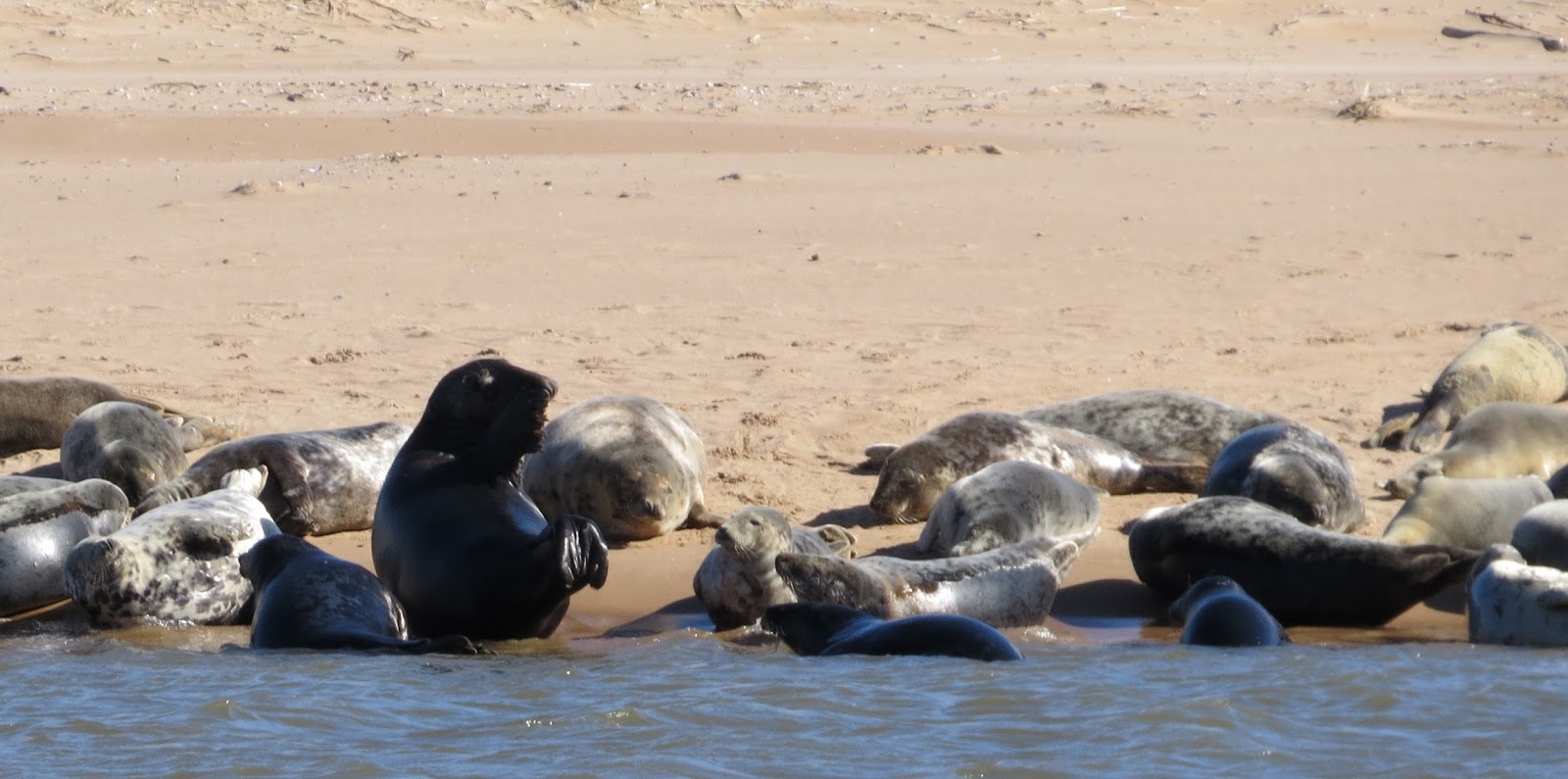
The previously mentioned mid-month trip to the Ythan Estuary gave great views of large numbers of Seals, many hauled-out on the shore, and some swimming and fishing, often at very close range....


Small Tortoiseshell
Butterflies were well represented this month, with August generally being the best month to see the common species and our local speciality, the Scotch Argus....


Common Blue
Ringlet
Scotch Argus
So August 2016 appears to have been a pretty good month for wildlife-watching in and around the Cairngorms National Park, with lots of good sightings, many memorable experiences, and the picturesque late summer scenery putting smiles on the faces of my safari clients who were visiting Scotland from all around the world......

My recently upgraded safari vehicle - a 7-seat Land Rover Discovery 4 HSE

Saturday, July 30, 2016

July 2016  started unseasonably 'grey', cold and wet in this area, with temperatures and conditions often more akin to spring or autumn, but it warmed up considerably from mid-month, with the second half of the month turning out to be warm and showery, and as long as you had appropriate clothing to hand to deal with the changeable conditions, it was a very enjoyable and successful month for wildlife sightings, and although the days are shortening slightly now, this far north there are still around 18 hours of usable daylight.
Full-day safari bird species day lists dropped a little, down into the 40's, as some of our wader species moved away from their upland breeding territories to the coasts, and things have definitely quietened down , as just about every bird species seems to have successfully raised and fledged youngsters now.
Mammal day lists varied between 3 and 9, depending on the length of day, and variety of habitats visited...with early starts generally producing more and better sightings, with again, many species seen with youngsters..
When the sun did shine, with the heather starting to turn a beautiful vivid purple, and the wild flowers and butterflies at their most abundant, Speyside really was a beautiful  and unspoilt place to be, and my safari clients, from many different countries, including Canada, USA, South Africa, Australia, Belgium and Holland all seemed to enjoy themselves.....

Midsummer at a beautiful local loch
To give you an idea of what you may realistically hope to see if you are planning a future July visit, I hope the following more detailed information, illustrated with photos taken by myself or my safari clients will help........


Wildlife highlights included:

Local speciality and upland bird species seen regularly throughout the month included:  Osprey,  Red Grouse, Slavonian Grebe, Red-Throated Diver, Black-Throated Diver, Crested Tit, Ring Ouzel, Goldeneye and Dipper.
We also enjoyed some regular good views of Peregrine, a few decent sightings of Golden Eagle, and  a couple of fleeting glimpses of Scottish Crossbill,  though sadly Capercaillie and Black Grouse (not unusually) were not seen at all this month....

Mammals seen regularly locally during the month included: Red Squirrel, Rabbit, Brown Hare, Roe Deer, Red Deer, Reindeer, Mountain Goat, and Bank Vole, with just a couple of sightings of Mountain Hare, Stoat, and another local upland speciality , Black Water Vole.  
A coastal excursion to the Moray Firth mid-month on one of the warm and sunny days provided great views of  Seals ....
Newly-fledged young Osprey
Our local Ospreys stole the show again this month, often being voted as 'Bird of the day' by my safari clients, with the adult birds seen fishing, delivering fish, and encouraging the fast growing 'scaly' looking youngsters to take their 'maiden flights', and by late-month they had indeed fledged and were seen perched, flying and fishing for the first time.. I can therefore highly recommend July as THE month for Osprey watching and photography in this area...

Red Grouse by Malcolm Fincham
Red Grouse too are always popular with my safari parties, as being a bird of uninhabited upland moors, most of my clients do not have them close to home. We, however, are fortunate to have lots of suitable heather moorland in this area, and throughout the month we enjoyed good close up views of families of these very characterful and beautifully marked birds.

Slavonian Grebe with chicks taking a ride by Steve Nicklin
Slavonian (Horned) Grebe, one of our rarest and surely one of our most beautiful British breeding birds, with the UK being at the very western limits of it's breeding range , have often struggled to breed successfully in this area in recent years, so it was great to see two of our local nesting pairs with youngsters this month, and we even got to see the very rare sight of the cute 'humbug' striped chicks taking a ride on the parents backs...

Red-Throated Diver
Divers (Loons) in their dapper summer plumage are always popular with my safari clients, and we were fortunate enough to get lots of good views of both Red-Throated and Black-Throated , both with well-grown youngsters, on their favoured local lochs throughout the month. It should be noted however, that they are rarely seen close to the shore, and are easily disturbed by non wildlife-friendly tourists dog-walking, swimming and boating etc, so early morning starts in search of them usually gave us our closest sightings....

Male Ring Ouzel
Ring Ouzels continued to show well in upland habitats near their nesting and feeding areas early in the month but became noticeably more elusive as the month progressed as they and their recently-fledged young began to roam further afield, and they appeared to have vacated this area for warmer climes by the end of the month....

Dipper
Dipper sightings were a bit hit and miss this month, with the birds seemingly quite mobile up and down the rivers, some days we saw none, and on other days we saw one on each river we visited! Which just goes to show that sometimes you need a bit of luck......

Crested Tits still took a bit of finding in our local Caledonian pine forests, with the ability to identify them by their distinctive calls and songs being vital if you are to have a chance. The ones we did see were mainly in  family groups, and constantly on the move....

It was a similar story with Crossbills too, with the majority of our sightings being of the rather frustrating 'fly-over' variety, with them only being identified by their characteristic 'jip' 'jip' calls as they travelled between different parts of the forests...

Golden Eagle is probably hardest to see in mid-summer (in this area at least), as the birds have so many hours of daylight in which to hunt, but we did manage a few decent though distant views of birds soaring on thermals...

Still on raptors, we also saw Peregrine, Red Kite, Common Buzzard, Kestrel and Sparrowhawk regularly during the month...

Golden Plover
Other good birds of note seen this month included:
Bullfinches, usually at quiet forest feeding stations , Golden Plover on the moors, and families of Redstarts and Spotted Flycatchers catching insects in our local forests....

Spotted Flycatcher
July is 'last chance saloon' for seeing all 3 of our mountain top species in one trip, and although I did not get the opportunity to take to the hills to see them myself, Ptarmigan, Dotterel and Snow Bunting were all reported by those that did...

Onto mammals now...

Red Squirrel
The award for 'mammal of the day' , as voted for by my safari clients, invariably went to that ever popular peanut-munching forest dweller, the cute and charismatic Red Squirrel, who can usually be relied upon to appear for an easy feast at my favourite forest feeding stations.....

Roe Deer  were seen frequently, at least early in the day anyway, and often heard 'barking' as they 'rutted' in suitable lowland areas. 

Red Deer stags
Red Deer were regularly seen in upland glens in large same-sex herds, the stags happily feeding and seemingly relaxing, and the hinds with their fast-growing young always nearby ....with many of my safari guests from foreign lands putting these iconic beasts high up on their 'wish-lists'....

Black water Vole by Bob Smith
Water Voles of the 'brown' variety, although generally in decline,  are not uncommon in many of the UK's suitable waterways, but up here in Scotland, especially the further north you go, we seem to have the much rarer 'black' variety, and we finally managed a few half-decent pics of them this month... You can read more about Scottish Water Voles at http://www.snh.org.uk/publications/on-line/wildlife/voles/biology.asp
Mountain Goat by safari client Norman Green
Mountain Goats , usually in large groups, were seen in a favourite upland glen on a number of occasions, though they were often a bit distant, we did get lucky with closer views on a couple of occasions....

The same could be said of our Mountain Hares too... though it should be noted that they are extremely difficult to find when in their mottled grey/brown summer plumage, as it seems to match the background rather well.....

Scotch Argus
Butterflies at last began to feature, on the few warmer sunny days at least!, with the more common species now being joined by our 'local speciality' the Scotch Argus towards the end of the month...

Wood Ants nest
Wood Ants are at their most active in the summer months, and walks in local forests revealed several huge nests, with thousands of worker ants frenziedly collecting and delivering caterpillars, insects and even beetles many times their own size!

So it looks like July 2016, despite the somewhat changeable weather, actually turned out to be another very good wildlife watching month in the Cairngorms National Park, with many memorable moments and lots of local specialities seen and enjoyed....happy days!! Though I must confess that I always tend to feel just a little sad at the end of every July , as I know that many of our summer visiting birds are soon to vacate our area and fly south to warmer climes as summer turns to early autumn next month.....

Sunset over the Moray Firth